
Auf Lager:2Buch (Hardcover): Fachbuch
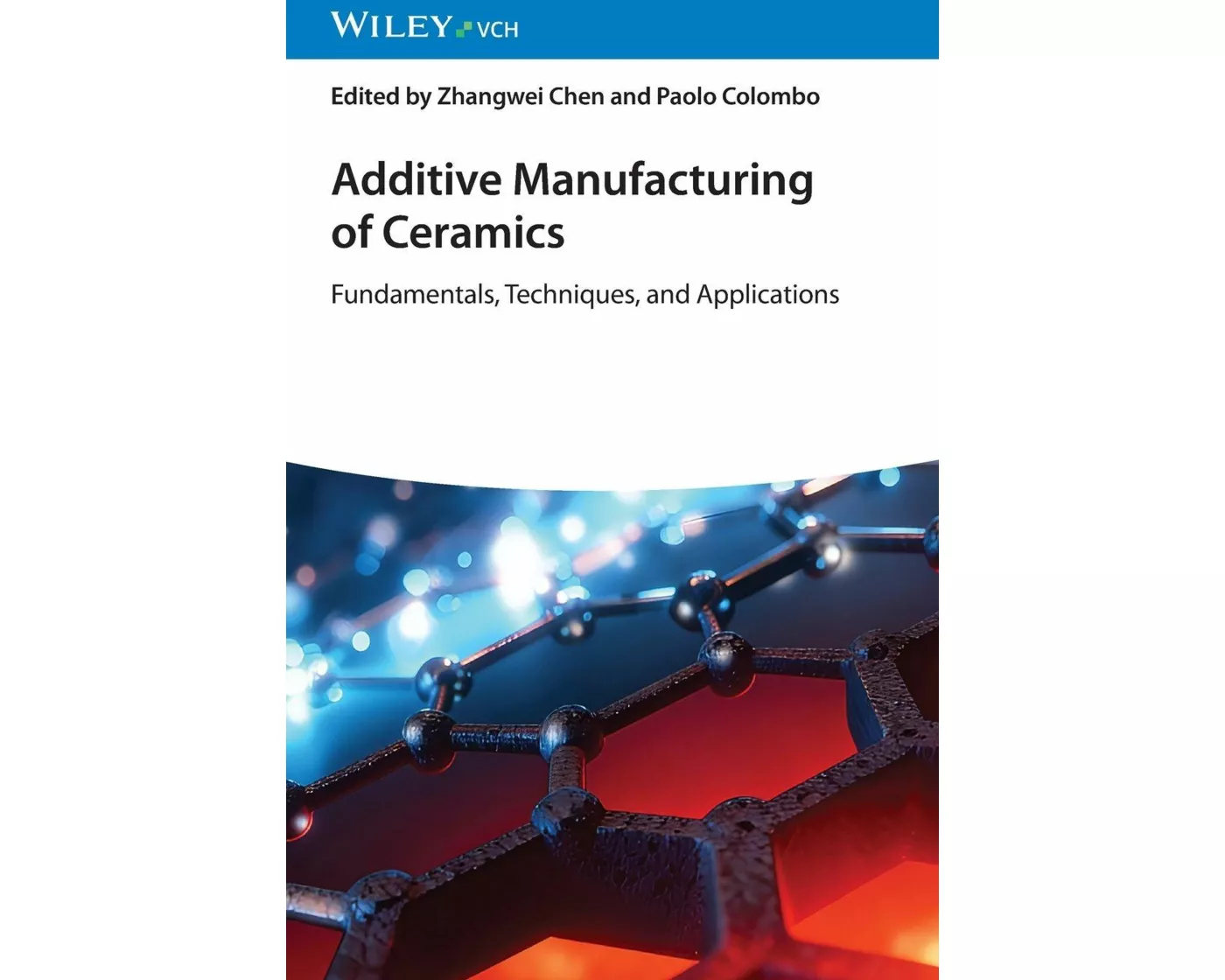
Additive Manufacturing of Ceramics
Fundamentals, Techniques and Applications
Herausgegeben von Paolo Colombo, Zhangwei Chen
- Verlag
- Wiley-VCH
- Unsere Artikel-Nr.
- P36402169
Beschreibung
Covers fundamentals, materials, techniques, processing, designs, characterizations, applications and equipment and future directions of additive manufacturing of ceramics.
Spezifikationen
| Sprache | Englisch |
|---|---|
| Autor | Paolo Colombo, Zhangwei Chen |
| Erscheinungsjahr | 2026 |
| Format | Buch (Hardcover) |
| Anzahl Seiten | 368 |
Inhaltsverzeichnis
Preface
1. Introduction
1.1 Most important properties and applications of ceramics
1.2. Typical processing routes and manufacturing techniques for ceramics
1.3. Challenges and the need for additive manufacturing
1.4. Brief introduction to ceramic additive manufacturing techniques
1.5. Summary of the book
1.6. Conclusions
References
2. Vat photopolymerization (VPP)
2.1. Introduction
2.2. Photopolymerization 3D printing processes for ceramic parts
2.3. Process modeling and simulation
2.4. Advantages and limits of VAT processes
2.5. AM hybridization opportunities
2.6. Next generation ceramic printing: Two photon photopolymerization and volumetric additive manufacturing methods
2.7 Conclusion
References
3. Binder Jetting (BJT) and Material jetting (MJT)
3.1. Inkjet printing
3.2 Binder Jetting (BJT)
3.3 Material Jetting (MJT)
3.4 Post-processes
References
4. Material extrusion (MEX)
4.1 Introduction
4.2 Direct ink writing
4.3 Fused filament fabrication
4.4 Heat treatment and post-processing
4.5 AM of fiber-reinforced composites
4.6 Summary
References
5. Powder bed fusion (PBF)
5.1. Short historical background of PBF
5.2. Terminology focus
5.3. Indirect - Powder Bed Selective Laser Processing (PBSLP)
5.4. Direct - Powder Bed Selective Laser Processing (PBSLP)
5.5. Process parameters PBF
5.6. Heat treatment and post-processing
5.7. Conclusion
References
6. Directed Energy Deposition (DED)
6.1. Introduction
6.2. Advantages and Limitations of DED
6.3. Powder Characteristics
6.4. DED Processing Related Challenges
6.5. Processing via DED
6.6. Monolithic Ceramics
6.7. Metal Matrix Composites via DED
6.8. Current Challenges and Future Directions
6.9. Summary
References
7. Hybrid AM of ceramics and AM of ceramic-based multi-material components
7.1. Hybrid Additive Manufacturing of ceramics
7.2. Additive Manufacturing of ceramic-based multi-material components
7.3. Applications
7.4. Conclusion and Outlook for AM of ceramic multi-material components
References
8. Design and characterization of AM of ceramics
8.1. Introduction
8.2. Model design - General rules for ceramic AM
8.3. Topological optimization and numerical simulation
8.4. Characterization of the feedstocks prior to printing
8.5. Characterization of the parts before and after heat processing
8.6. Summary
References
9. Industrial VPP equipment for AM of functional ceramic composites
9.1. Introduction
9.2. Materials and Rheology
9.3. Processing
9.4. Reproducibility
9.5. Quality Management, Compliance, and Performance Metrics
9.6. Economic and Regulatory Considerations
9.7. Industrial applications of lithography based ceramic AM
9.8. Market considerations and selection guidance
9.9. Multi-material additive manufacturing
9.10. Multi-material AM of ceramic composites with LCM
9.11. Applications for LCM multi-material printing
9.12. Future research
9.13. Summary
References
10. Applications and Impacts of AM of Ceramics
10.1. Aerospace and defense applications
10.2. Chemical applications
10.3. Electronic and semiconductor applications
10.4. Biomedical applications
10.5. Detailed case studies of ceramic AM applications
10.6. Cross-domain value and systemic impact of ceramic additive manufacturing
10.7. Conclusion
References
11. New Developments and Perspectives
11.1. Introduction
11.2. Green/smart design and manufacturing
11.3. 4D/5D Printing
11.4. Potentials and Challenges
References
Bewertungen
Produkt bewertenFür dieses Produkt liegt noch keine Bewertung vor. Wenn Sie es gekauft haben, teilen Sie gerne Ihre Erfahrung.
Zahlungsarten


Rechnung (Einzahlungsschein mit QR-Code), Twint, Kreditkarte, PostFinance, Apple, Google oder Samsung Pay.
Versand
Kostenlos: Schweiz & Liechtenstein
Rückgabe
Kein Rückgaberecht
Bei diesem Produkt hat entweder der Hersteller/Verlag das Rückgaberecht ausgeschlossen oder eine Rückgabe ist aufgrund des Vertriebssystems nicht möglich.