
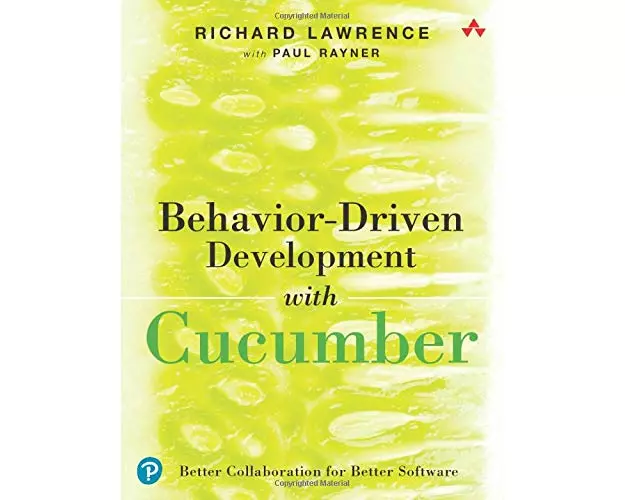
Behavior-Driven Development with Cucumber: Better Collaboration for Better Software
von Richard Lawrence, Paul Rayner
- Verlag
- Pearson
- Unsere Artikel-Nr.
- 2WV7374
Beschreibung
Spezifikationen
| Sprache | Englisch |
|---|---|
| Autor | Richard Lawrence, Paul Rayner |
| Thema | Softwareentwicklung: Programmiersprachen |
| Auflage | 1 |
| Erscheinungsjahr | 2019 |
| Erscheinungsland | USA |
| Format | Buch (Softcover) |
| Anzahl Seiten | 208 |
Inhaltsverzeichnis
Chapter 1: Focusing on Value<\/p>
<\/p>
When Scrum Isn't Enough<\/p>
Finding a High-Value Feature to Start With<\/p>
Before You Start with Cucumber<\/p>
Finding the First MMF<\/p>
Slicing an MMF into User Stories<\/p>
Summary<\/p>
Reference<\/p>
Chapter 2: Exploring with Examples<\/p>
BDD Is a Cooperative Game<\/p>
BDD Is a Whole Team Thing<\/p>
Allow Time and Space to Learn<\/p>
Flesh Out the Happy Path First<\/p>
Use Real Examples<\/p>
Example Mapping Gives the Discussion Structure<\/p>
Optimizing for Discovery<\/p>
Addressing Some Concerns<\/p>
Treat Resistance as a Resource<\/p>
Playing the BDD Game<\/p>
Opening<\/p>
Exploring<\/p>
Closing<\/p>
Summary<\/p>
References<\/p>
Chapter 3: Formalizing Examples into Scenarios<\/p>
Moving from Examples to Scenarios<\/p>
Feature Files as Collaboration Points<\/p>
BDD Is Iterative, Not Linear<\/p>
Finding the Meaningful Variations<\/p>
Gherkin: A Language for Expressive Scenarios<\/p>
Summary<\/p>
Resources<\/p>
Chapter 4: Automating Examples<\/p>
The Test Automation Stack<\/p>
Adjusting to Working Test-First<\/p>
Annotating Element Names in Mockups<\/p>
How Does User Experience Design Fit In to This?<\/p>
Did They Really Just Hard Code Those Results?<\/p>
Anatomy of a Step Definition<\/p>
Simple Cucumber Expressions<\/p>
Regular Expressions<\/p>
Anchors<\/p>
Wildcards and Quantifiers<\/p>
Capturing and Not Capturing<\/p>
Just Enough<\/p>
Custom Cucumber Expressions Parameter Types<\/p>
Beyond Ruby<\/p>
Slow Is Normal (at First)<\/p>
Choose Cucumber Based on Audience, Not Scope<\/p>
Summary<\/p>
Chapter 5: Frequent Delivery and Visibility<\/p>
How BDD Changes the Tester's Role<\/p>
Exploratory Testing<\/p>
BDD and Automated Builds<\/p>
Faster Stakeholder Feedback<\/p>
How Getting to Done More Often Changes All Sorts of Things<\/p>
Frequent Visibility and Legacy Systems<\/p>
Documentation: Integrated and Living<\/p>
Avoiding Mini-Waterfalls and Making the Change Stick<\/p>
Summary<\/p>
References<\/p>
Chapter 6: Making Scenarios More Expressive<\/p>
Feedback About Scenarios<\/p>
How to Make Your Scenarios More Expressive<\/p>
Finding the Right Level of Abstraction<\/p>
Including the Appropriate Details<\/p>
Expressive Language in the Steps<\/p>
Refactoring Scenarios<\/p>
Good Scenario Titles<\/p>
Summary<\/p>
References<\/p>
Chapter 7: Growing Living Documentation<\/p>
What Is Living Documentation and Why Is It Better?<\/p>
Cucumber Features and Other Documentation<\/p>
Avoid Gherkin in User Story Descriptions<\/p>
The Unexpected Relationship Between Cucumber Features and User Stories<\/p>
Stable Scenarios<\/p>
Growing and Splitting Features<\/p>
Split When Backgrounds Diverge<\/p>
Split When a New Domain Concept Emerges<\/p>
Secondary Organization Using Tags<\/p>
Structure Is Emergent<\/p>
Summary<\/p>
Chapter 8: Succeeding with Scenario Data<\/p>
Characteristics of Good Scenarios<\/p>
Independent<\/p>
Repeatable<\/p>
Researchable<\/p>
Realistic<\/p>
Robust<\/p>
Maintainable<\/p>
Fast<\/p>
Sharing Data<\/p>
When to Share Data<\/p>
Raising the Level of Abstraction with Data Personas<\/p>
Data Cleanup<\/p>
Summary<\/p>
Reference<\/p>
Chapter 9: Conclusion<\/p>
<\/p>
<\/p>
9780321772633 TOC 4\/22\/2019<\/p>"
Bewertungen
Produkt bewertenFür dieses Produkt liegt noch keine Bewertung vor. Wenn Sie es gekauft haben, teilen Sie gerne Ihre Erfahrung.
Zahlungsarten


Rechnung (Einzahlungsschein mit QR-Code), Twint, Kreditkarte, PostFinance, Apple, Google oder Samsung Pay.
Versand
Kostenlos: Schweiz & Liechtenstein
Rückgabe
30 Tage Rückgaberecht
Sie können das Produkt innerhalb von 30 Wochentagen ohne Angabe von Gründen zurücksenden, sofern es unbeschädigt und in der Originalverpackung ist.
Weitere Hinweise finden Sie in unseren AGB unter D.1.