
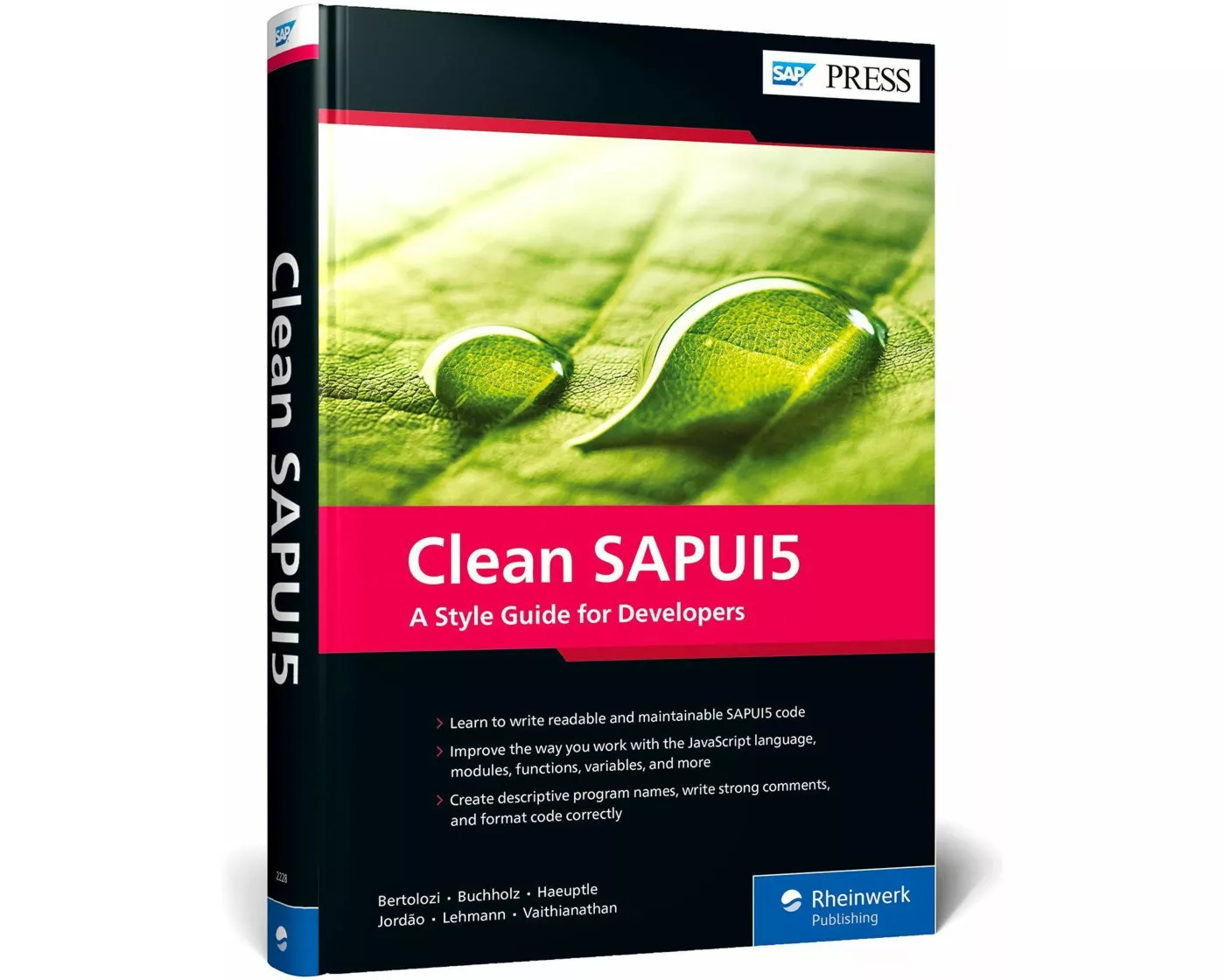
von Klaus Haeuptle, Rodrigo Jordão, Christian Lehmann
- Verlag
- Rheinwerk Publishing
- Unsere Artikel-Nr.
- QWW79EP
Beschreibung
SAPUI5 code needs to be easy to read and easy to update. Clean up your code with this guide from the experts. Learn how to leverage JavaScript features to write better SAPUI5 code. Then walk through detailed code examples and explanations for using modules, classes, functions, names, variables, literals, comments, code metrics, and more. Get the best practices you need for formatting, testing, implementation, and beyond. In this book, you’ll learn about: a. Key Concepts Understand the foundation of SAPUI5: JavaScript. Explore key JavaScript ES6 features such as arrow functions, spread syntax, and more. Then walk through different types of SAPUI5 projects, from library projects to freestyle applications. b. Best Practices Learn the rules for clean code. Dive into best practices for decoupling modules, structuring functions, declaring variables and literals, using control flow statements and loops, handling errors, performing automated tests, and more. c. Practical ExamplesPut theory into practice. Use detailed code examples for each concept to help you differentiate between clean and messy SAPUI5 code. Highlights include: 1) JavaScript 2) Modules and classes 3) Functions 4) Naming 5) Variables and literals 6) Control flow 7) Formatting8) Error handling 9) Comments10) Static code checks 11) Testing12) Implementation.
Spezifikationen
| Sprache | Englisch |
|---|---|
| Autor | Klaus Haeuptle, Rodrigo Jordão, Christian Lehmann, Daniel Bertolozi, Arnaud Buchholz, Narendran Natarajan Vaithianathan |
| Kollektion | SAP PRESS Englisch |
| Auflage | 1 |
| Erscheinungsjahr | 2022 |
| Erscheinungsland | Deutschland |
| Format | Buch (Hardcover) |
| Anzahl Seiten | 530 |
Inhaltsverzeichnis
... Preface ... 17
... Who This Book Is For ... 17
... How This Book Is Organized ... 18
... Acknowledgments ... 20
... Conclusion ... 22
1 ... Introduction ... 23
1.1 ... What Is Clean SAPUI5? ... 23
1.2 ... How to Get Started with Clean SAPUI5 ... 26
1.3 ... How to Handle Legacy Code ... 27
1.4 ... How to Check Code Automatically ... 29
1.5 ... How Does Clean SAPUI5 Relate to Other Guides? ... 29
1.6 ... Summary ... 30
2 ... JavaScript and SAPUI5 ... 31
2.1 ... JavaScript ES6+ Features ... 32
2.2 ... TypeScript ... 106
2.3 ... Summary ... 117
3 ... Project Structure ... 119
3.1 ... Components in SAPUI5 ... 119
3.2 ... Important Artifacts ... 122
3.3 ... Freestyle Applications ... 129
3.4 ... SAP Fiori Elements ... 132
3.5 ... Library Projects ... 139
3.6 ... Model-View-Controller Assets ... 142
3.7 ... Summary ... 144
4 ... Modules and Classes ... 147
4.1 ... Controller Inflation ... 148
4.2 ... Module Lifecycle ... 179
4.3 ... Reusability and Testability ... 187
4.4 ... Service Modules versus Class Modules ... 197
4.5 ... Summary ... 204
5 ... Functions ... 205
5.1 ... Function Definition ... 205
5.2 ... The Function Object ... 206
5.3 ... Instance Methods ... 208
5.4 ... Event Handlers and Callbacks ... 211
5.5 ... Callback Execution Context ... 211
5.6 ... Getters and Setters ... 213
5.7 ... Anonymous Functions ... 215
5.8 ... Function Parameters ... 217
5.9 ... Promises ... 230
5.10 ... Generators ... 236
5.11 ... Function Body ... 237
5.12 ... Invoking Functions ... 245
5.13 ... Closures ... 247
5.14 ... Summary ... 248
6 ... Naming ... 249
6.1 ... Descriptive Names ... 249
6.2 ... Domain Terms ... 251
6.3 ... Design Patterns ... 252
6.4 ... Consistency ... 253
6.5 ... Shortening Names ... 254
6.6 ... Noise Words ... 255
6.7 ... Casing ... 255
6.8 ... Classes and Enums ... 257
6.9 ... Functions and Methods ... 258
6.10 ... Variables and Parameters ... 260
6.11 ... Private Members ... 265
6.12 ... Namespaces ... 267
6.13 ... Control IDs ... 268
6.14 ... Hungarian Notation ... 270
6.15 ... Alternative Rules ... 271
6.16 ... Summary ... 273
7 ... Variables and Literals ... 275
7.1 ... Variables ... 275
7.2 ... Literals ... 279
7.3 ... Summary ... 297
8 ... Control Flow ... 299
8.1 ... Conditionals ... 299
8.2 ... Loops ... 303
8.3 ... Conditional Complexity ... 306
8.4 ... Summary ... 313
9 ... Error Handling ... 315
9.1 ... throw and try/catch Statements ... 315
9.2 ... Using Error Objects ... 317
9.3 ... Error Handling Using Messages ... 318
9.4 ... Error Handling Using Controls ... 320
9.5 ... Error Handling Best Practices ... 323
9.6 ... Summary ... 327
10 ... Formatting ... 329
10.1 ... Motivation ... 329
10.2 ... Vertical versus Horizontal Formatting ... 330
10.3 ... Indentation ... 339
10.4 ... XML Views ... 341
10.5 ... Additional Considerations ... 347
10.6 ... Formatting for TypeScript in SAPUI5 ... 351
10.7 ... Building and Maintaining a Code Style Guide ... 361
10.8 ... Formatting Tools ... 363
10.9 ... Summary ... 368
11 ... Comments ... 369
11.1 ... Express Yourself in Code ... 369
11.2 ... The Good: Comment Placement and Usage ... 371
11.3 ... The Bad: Comments to Avoid or Refactor ... 381
11.4 ... The Ugly: Special Comments ... 391
11.5 ... Summary ... 394
12 ... Static Code Checks and Code Metrics ... 397
12.1 ... Linting ... 399
12.2 ... Code Metrics ... 417
12.3 ... Summary ... 437
13 ... Testing ... 439
13.1 ... Principles ... 440
13.2 ... Code under Test ... 451
13.3 ... Injection ... 453
13.4 ... Test Methods and Journeys ... 458
13.5 ... Test Data ... 461
13.6 ... Assertions ... 464
13.7 ... Summary ... 470
14 ... TypeScript and Related Technologies ... 471
14.1 ... TypeScript ... 471
14.2 ... Web Components ... 485
14.3 ... Fundamental Library ... 494
14.4 ... Summary ... 498
15 ... Implementing Clean SAPUI5 ... 499
15.1 ... A Common Understanding among Team Members ... 499
15.2 ... Collective Code Ownership ... 500
15.3 ... Clean Code Developer Initiative ... 501
15.4 ... Tackling the Broken Window Effect ... 503
15.5 ... Code Review and Learning ... 506
15.6 ... Clean Code Advisors ... 509
15.7 ... Learning Techniques ... 510
15.8 ... Continuous Learning in Cross-Functional Teams ... 514
15.9 ... Summary ... 516
... The Authors ... 517
... Index ... 519
Bewertungen
Produkt bewertenFür dieses Produkt liegt noch keine Bewertung vor. Wenn Sie es gekauft haben, teilen Sie gerne Ihre Erfahrung.
Zahlungsarten


Rechnung (Einzahlungsschein mit QR-Code), Twint, Kreditkarte, PostFinance, Apple, Google oder Samsung Pay.
Versand
Kostenlos: Schweiz & Liechtenstein
Rückgabe
Kein Rückgaberecht
Bei diesem Produkt hat entweder der Hersteller/Verlag das Rückgaberecht ausgeschlossen oder eine Rückgabe ist aufgrund des Vertriebssystems nicht möglich.