
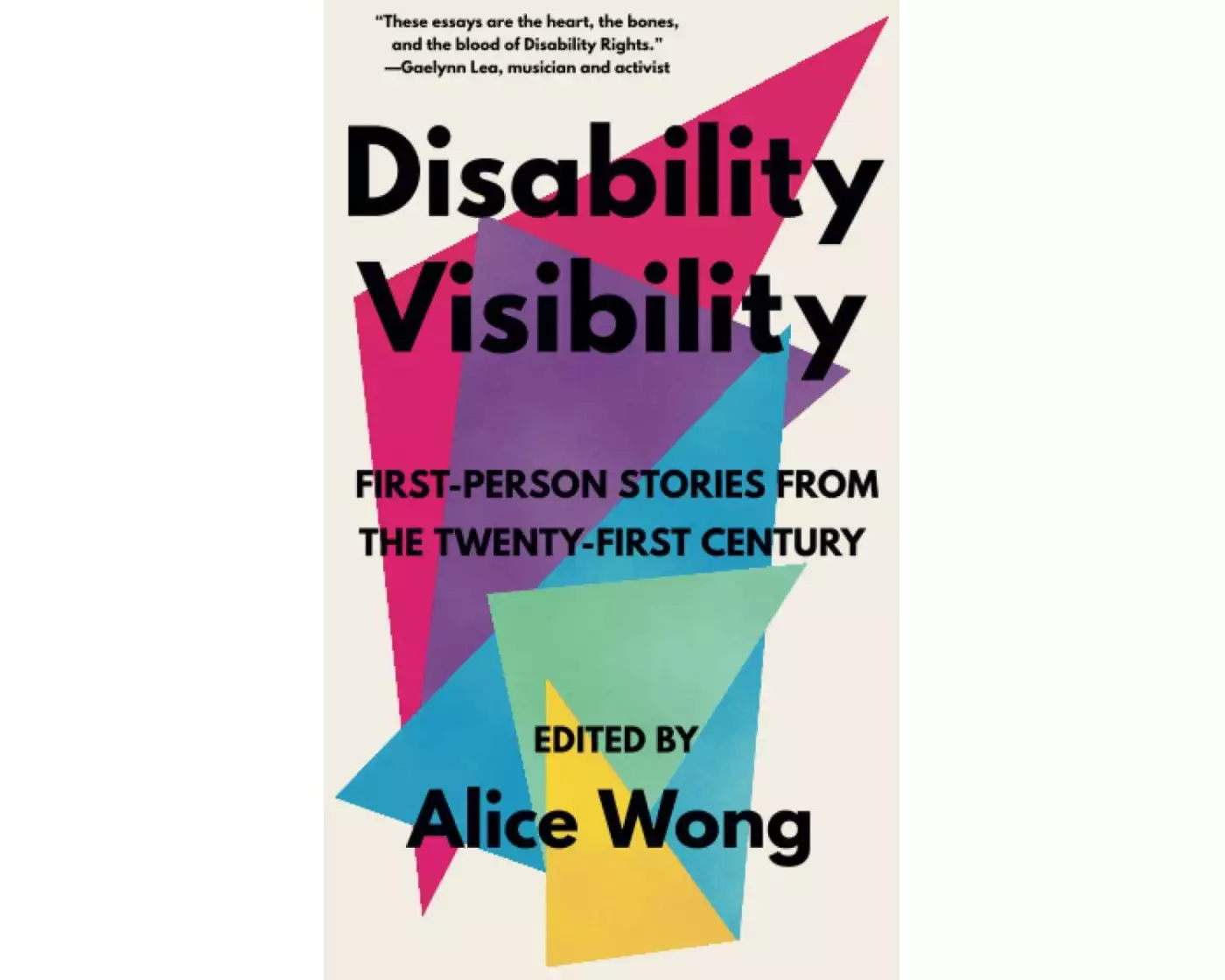
Disability Visibility
First-Person Stories from the Twenty-first Century
von Alice Wong
- Verlag
- Penguin Random House
- Unsere Artikel-Nr.
- GD84QQ8
Beschreibung
Spezifikationen
| Sprache | Englisch |
|---|---|
| Autor | Alice Wong |
| Thema | Literatur: Tagebücher & Briefe |
| Erscheinungsjahr | 2020 |
| Format | Buch (Softcover) |
| Anzahl Seiten | 336 |
Inhaltsverzeichnis
Introduction by Alice Wong <\/i><\/p>
PART 1: BEING<\/p>
Unspeakable Conversations
<\/i>Harriet McBryde Johnson<\/p>
For Ki’tay D. Davidson, Who Loves Us
<\/i>Talila A. Lewis<\/p>
If You Can’t Fast, Give
<\/i>Maysoon Zayid<\/p>
There’s a Mathematical Equation That Proves I’m Ugly—Or So I Learned in My Seventh-Grade Art Class
<\/i>Ariel Henley<\/p>
The Erasure of Indigenous People in Chronic Illness
<\/i>Jen Deerinwater<\/p>
When You Are Waiting to Be Healed
<\/i>June Eric-Udorie<\/p>
The Isolation of Being Deaf in Prison
<\/i>Jeremy Woody, as told to Christie Thompson <\/p>
Common Cyborg
<\/i>Jillian Weise<\/p>
I’m Tired of Chasing a Cure
<\/i>Liz Moore<\/p>
PART 2: BECOMING<\/p>
We Can’t Go Back
<\/i>Ricardo T. Thornton Sr.<\/p>
Radical Visibility: A Disabled Queer Clothing Reform Movement Manifesto
<\/i>Sky Cubacub<\/p>
Guide Dogs Don’t Lead Blind People. We Wander as One.
<\/i>Haben Girma<\/p>
Taking Charge of My Story as a Cancer Patient at the Hospital Where I Work
<\/i>Diana Cejas<\/p>
Canfei to Canji: The Freedom of Being Loud
<\/i>Sandy Ho<\/p>
Nurturing Black Disabled Joy
<\/i>Keah Brown<\/p>
Last but Not Least —<\/i> Embracing Asexuality
<\/i>Keshia Scott <\/p>
Imposter Syndrome and Parenting with a Disability
<\/i>Jessica Slice <\/p>
How to Make a Paper Crane from Rage
<\/i>Elsa Sjunneson<\/p>
Selma Blair Became a Disabled Icon Overnight. Here’s Why We Need More Stories Like Hers.
<\/i>Zipporah Arielle<\/p>
PART 3: DOING<\/p>
Why My Novel Is Dedicated to My Disabled Friend Maddy
<\/i>A. H. Reaume<\/p>
The Antiabortion Bill You Aren’t Hearing About
<\/i>Rebecca Cokley<\/p>
So. Not. Broken.
<\/i>Alice Sheppard<\/p>
How a Blind Astronomer Found a Way to Hear the Stars
<\/i>Wanda Díaz-Merced<\/p>
Incontinence Is a Public Health Issue—And We Need to Talk About It
<\/i>Mari Ramsawakh<\/p>
Falling\/Burning: Hannah Gadsby, <\/i>Nanette, and Being a Bipolar Creator
<\/i>Shoshana Kessock<\/p>
Six Ways of Looking at Crip Time
<\/i>Ellen Samuels<\/p>
Lost Cause
<\/i>Reyma McCoy McDeid <\/p>
On NYC’s Paratransit, Fighting for Safety, Respect, and Human Dignity
<\/i>Britney Wilson<\/p>
Gaining Power through Communication Access
<\/i>Lateef McLeod<\/p>
PART 4: CONNECTING<\/p>
The Fearless Benjamin Lay: Activist, Abolitionist, Dwarf Person
<\/i>Eugene Grant<\/p>
To Survive Climate Catastrophe, Look to Queer and Disabled Folks
<\/i>Patty Berne, as told to and edited by Vanessa Raditz<\/p>
Disability Solidarity: Completing the “Vision for Black Lives”
<\/i>Harriet Tubman Collective<\/p>
Time’s Up for Me, Too
<\/i>Karolyn Gehrig <\/p>
Still Dreaming Wild Disability Justice Dreams at the End of the World
<\/i>Leah Lakshmi Piepzna- Samarasinha <\/p>
Love Means Never Having to Say . . . Anything
<\/i>Jamison Hill <\/p>
On the Ancestral Plane: Crip Hand- Me Downs and the Legacy of Our Movements
<\/i>Stacey Milbern<\/p>
The Beauty of Spaces Created for and by Disabled People
<\/i>s.e. smith<\/p>
<\/p>
About the Editor <\/i><\/p>
About the Contributors <\/i><\/p>
Further Reading<\/i><\/p>"
Leserkritik
ENTROPY'S BEST OF NONFICTION
“Disability rights activist Alice Wong brings tough conversations to the forefront of society with this anthology. It sheds light on the experience of life as an individual with disabilities, as told by none other than authors with these life experiences. It's an eye-opening collection that readers will revisit time and time again.” —Chicago Tribune
“Shares perspectives that are too often missing from such decision-making about accessibility.” —The Washington Post
“Implicitly (and sometimes explicitly) makes the case for acknowledging and accommodating society’s overlooked population of disabled people.” —The New York Times Book Review
“An exemplary collection. . . . This month’s #RequiredReading.” —Ms. Magazine
“A raw, emotional collection, an investment in the power of storytelling to foster vibrant connections, and an unapologetic rejection of ‘internalized ableism’. . . . The 37 powerful stories in Disability Visibility reveal the depth of everyday courage and the extraordinary human capacity to find humor in the face of life’s adversities.” —Shelf Awareness
“Roughly 15 percent of people around the world have a disability, and yet their stories are often never told. Alice Wong’s anthology, Disability Visibility, brings their narratives front and center with the goal of showcasing the wide range of modern disability experiences. . . . Ultra-impressive.” —Shondaland, "10 Books Set to Become the New Feminist Classics"
“By its very nature, the disability community is incredibly intersectional and diverse, including people from all walks of life, backgrounds, and cultures. Disability Visibility reflects that diversity with its contributors, giving . . . a look at a wide range of experiences and types of disability.” —Book Riot
“Alice Wong . . . has long been at the forefront of the disability justice movement.” —Bitch Media, “17 Books Feminists Should Read in June”
“More resonant than ever. In this kaleidoscopic collection, Wong and her contributors provide not just a snapshot of what disability has meant in the past 20 years, but an urgent invitation to take that understanding forward. . . . A landmark resource for understanding disability.” —Autostraddle
“Diverse and poignant. . . . I was deeply moved by more pieces than I could name.” —Shir Kehila, Columbia Journal
“Every piece in Disability Visibility evokes . . . tenacity, some gut-wrenching and others inspiring. . . . The range of subjects is impressive: assistive technologies, carceral injustice, fashion, homophobia and heterosexism, medical care and medical abuse, organizing strategies, psychotherapy, racism, relationships, sex, and sexism.” —The Progressive
“Celebrates and documents the lived experiences, power, and culture of the disabled community.” —Morning Brew
“Wong’s discerning selections, bolstered by the activism that shines through, will educate and inspire readers.” —Kirkus Reviews
“These essays are the heart, the bones, and the blood of Disability Rights.” —Gaelynn Lea, musician and activist
“To Alice Wong, words like diversity and intersectionality aren’t just buzzwords. They are marching orders. Everyone should take in the wisdom woven throughout this book.” —W. Kamau Bell, host of United Shades of America
“A celebration and a source of deep education for many to bear witness (and feel seen by) the vastness of disabled stories, voices, and backgrounds.” —Jennifer Baker, editor of Everyday People: The Color of Life
“As a Deaf Asian American, it wasn’t until recent years that I started considering myself disabled. This is a very informed starting point for anyone who, like myself, would like to get a better understanding of disability as a massive and beautifully nuanced spectrum.” —Christine Sun Kim, artist
Bewertungen
Produkt bewertenFür dieses Produkt liegt noch keine Bewertung vor. Wenn Sie es gekauft haben, teilen Sie gerne Ihre Erfahrung.
Zahlungsarten


Rechnung (Einzahlungsschein mit QR-Code), Twint, Kreditkarte, PostFinance, Apple, Google oder Samsung Pay.
Versand
Kostenlos: Schweiz & Liechtenstein
Rückgabe
30 Tage Rückgaberecht
Sie können das Produkt innerhalb von 30 Wochentagen ohne Angabe von Gründen zurücksenden, sofern es unbeschädigt und in der Originalverpackung ist.
Weitere Hinweise finden Sie in unseren AGB unter D.1.