
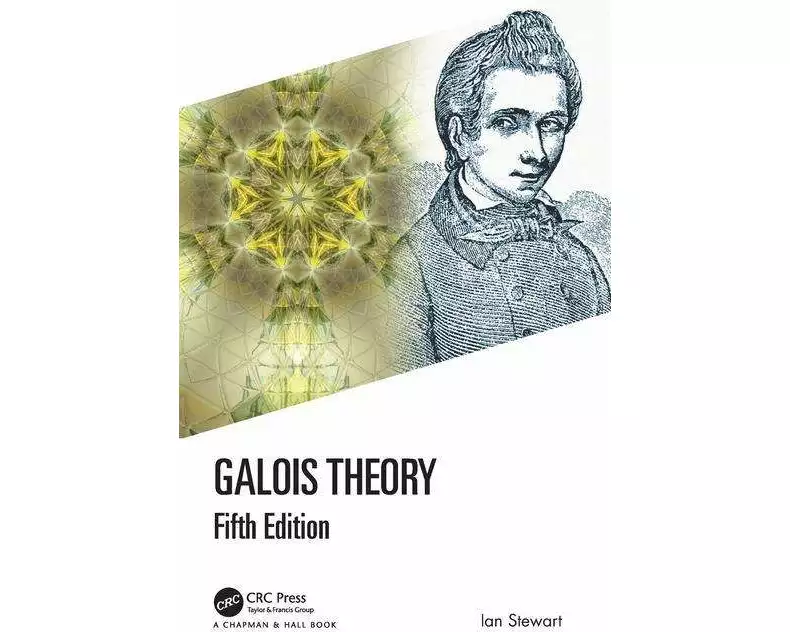
Galois Theory
von Ian Stewart
- Verlag
- Taylor & Francis
- Unsere Artikel-Nr.
- E33Q38E
Beschreibung
Spezifikationen
| Sprache | Englisch |
|---|---|
| Autor | Ian Stewart |
| Thema | Mathematik: Allgemein |
| Zielgruppe | Undergraduate Core |
| Auflage | 5 |
| Erscheinungsjahr | 2022 |
| Format | Buch (Softcover) |
| Anzahl Seiten | 353 |
Inhaltsverzeichnis
1. Classical Algebra.<\/strong> 1.1. Complex Numbers. 1.2. Subfields and Subrings of the Complex Numbers. 1.3. Solving Equations. 1.4. Solution by Radicals. 2. The Fundamental Theorem of Algebra.<\/strong> 2.1. Polynomials. 2.2. Fundamental Theorem of Algebra. 2.3. Implications 3. Factorisation of Polynomials.<\/strong> 3.1. The Euclidean Algorithm. 3.2 Irreducibility. 3.3. Gauss\u2019s Lemma. 3.4. Eisenstein\u2019s Criterion. 3.5. Reduction Modulo p. <\/i>3.6. Zeros of Polynomials. 4. Field Extensions.<\/strong> 4.1. Field Extensions. 4.2. Rational Expressions. 4.3. Simple Extensions. 5. Simple Extensions.<\/strong> 5.1. Algebraic and Transcendental Extensions. 5.2. The Minimal Polynomial. 5.3. Simple Algebraic Extensions. 5.4. Classifying Simple Extensions. 6. The Degree of an Extension.<\/strong> 6.1. Definition of the Degree. 6.2. The Tower Law. 6.3. Primitive Element Theorem. 7. Ruler-and-Compass Constructions.<\/strong> 7.1. Approximate Constructions and More General Instruments. 7.2. Constructions in C. 7.3. Specific Constructions. 7.4. Impossibility Proofs. 7.5. Construction From a Given Set of Points. 8. The Idea Behind Galois Theory.<\/strong> 8.1. A First Look at Galois Theory. 8.2. Galois Groups According to Galois. 8.3. How to Use the Galois Group. 8.4. The Abstract Setting. 8.5. Polynomials and Extensions. 8.6. The Galois Correspondence. 8.7. Diet Galois. 8.8. Natural Irrationalities. 9. Normality and Separability.<\/strong> 9.1. Splitting Fields. 9.2. Normality. 9.3. Separability. 10. Counting Principles.<\/strong> 10.1. Linear Independence of Monomorphisms. 11. Field Automorphisms.<\/strong> 11.1. K<\/i>-Monomorphisms. 11.2. Normal Closures. 12. The Galois Correspondence.<\/strong> 12.1. The Fundamental Theorem of Galois Theory. 13. Worked Examples. <\/strong>13.1. Examples of Galois Groups. 13.2. Discussion. 14. Solubility and Simplicity.<\/strong> 14.1. Soluble Groups. 14.2. Simple Groups. 14.3. Cauchy\u2019s Theorem. 15. Solution by Radicals.<\/strong> 15.1. Radical Extensions. 15.2. An Insoluble Quintic. 15.3. Other Methods. 16. Abstract Rings and Fields.<\/strong> 16.1. Rings and Fields. 16.2. General Properties of Rings and Fields. 16.3. Polynomials Over General Rings. 16.4. The Characteristic of a Field. 16.5. Integral Domains. 17. Abstract Field Extensions and Galois Groups.<\/strong> 17.1. Minimal Polynomials. 17.2. Simple Algebraic Extensions. 17.3. Splitting Fields. 17.4. Normality. 17.5. Separability. 17.6. Galois Theory for Abstract Fields. 17.7. Conjugates and Minimal Polynomials. 17.8. The Primitive Element Theorem. 17.9. Algebraic Closure of a Field. 18. The General Polynomial Equation.<\/strong> 18.1. Transcendence Degree. 18.2. Elementary Symmetric Polynomials. 18.3. The General Polynomial. 18.5. Solving Equations of Degree Four or Less. 18.6. Explicit Formulas. 19. Finite Fields.<\/strong> 19.1. Structure of Finite Fields. 19.2. The Multiplicative Group. 19.3. Counterexample to the Primitive Element Theorem. 19.4. Application to Solitaire. 20. Regular Polygons.<\/strong> 20.1. What Euclid Knew. 20.2. Which Constructions are Possible? 20.3. Regular Polygons. 20.4. Fermat Numbers. 20.5. How to Construct a Regular 17-gon. 21. Circle Division.<\/strong> 21.1. Genuine Radicals. 21.2. Fifth Roots Revisited. 21.3. Vandermonde Revisited. 21.4. The General Case. 21.5. Cyclotomic Polynomials. 21.6. Galois Group of Q(\u03b6)= <\/i>Q. 21.7. Constructions Using a Trisector. 22. Calculating Galois Groups.<\/strong> 22.1. Transitive Subgroups. 22.2. Bare Hands on the Cubic. 22.3. The Discriminant. 22.4. General Algorithm for the Galois Group. 23. Algebraically Closed Fields.<\/strong> 23.1. Ordered Fields and Their Extensions. 23.2. Sylow\u2019s Theorem. 23.3. The Algebraic Proof. 24. Transcendental Numbers.<\/strong> 24.1. Irrationality. 24.2. Transcendence of e. 24.3. Transcendence of \u03c0. 25. What Did Galois Do or Know?<\/strong> 25.1. List of the Relevant Material. 25.2. The First Memoir. 25.3. What Galois Proved. 25.4. What is Galois Up To? 25.5. Alternating Groups, Especially A5. 25.6. Simple Groups Known to Galois. 25.7. Speculations about Proofs. 25.8. A5 is Unique. 26. Further Directions.<\/strong> 26.1. Inverse Galois Problem. 26.2. Differential Galois Theory. 26.3. p<\/i>-adic Numbers.<\/p>"
Bewertungen
Produkt bewertenFür dieses Produkt liegt noch keine Bewertung vor. Wenn Sie es gekauft haben, teilen Sie gerne Ihre Erfahrung.
Zahlungsarten


Rechnung (Einzahlungsschein mit QR-Code), Twint, Kreditkarte, PostFinance, Apple, Google oder Samsung Pay.
Versand
Kostenlos: Schweiz & Liechtenstein
Rückgabe
30 Tage Rückgaberecht
Sie können das Produkt innerhalb von 30 Wochentagen ohne Angabe von Gründen zurücksenden, sofern es unbeschädigt und in der Originalverpackung ist.
Weitere Hinweise finden Sie in unseren AGB unter D.1.