
Erhältlich:Nicht auf LagerBuch (Softcover): Fachbuch
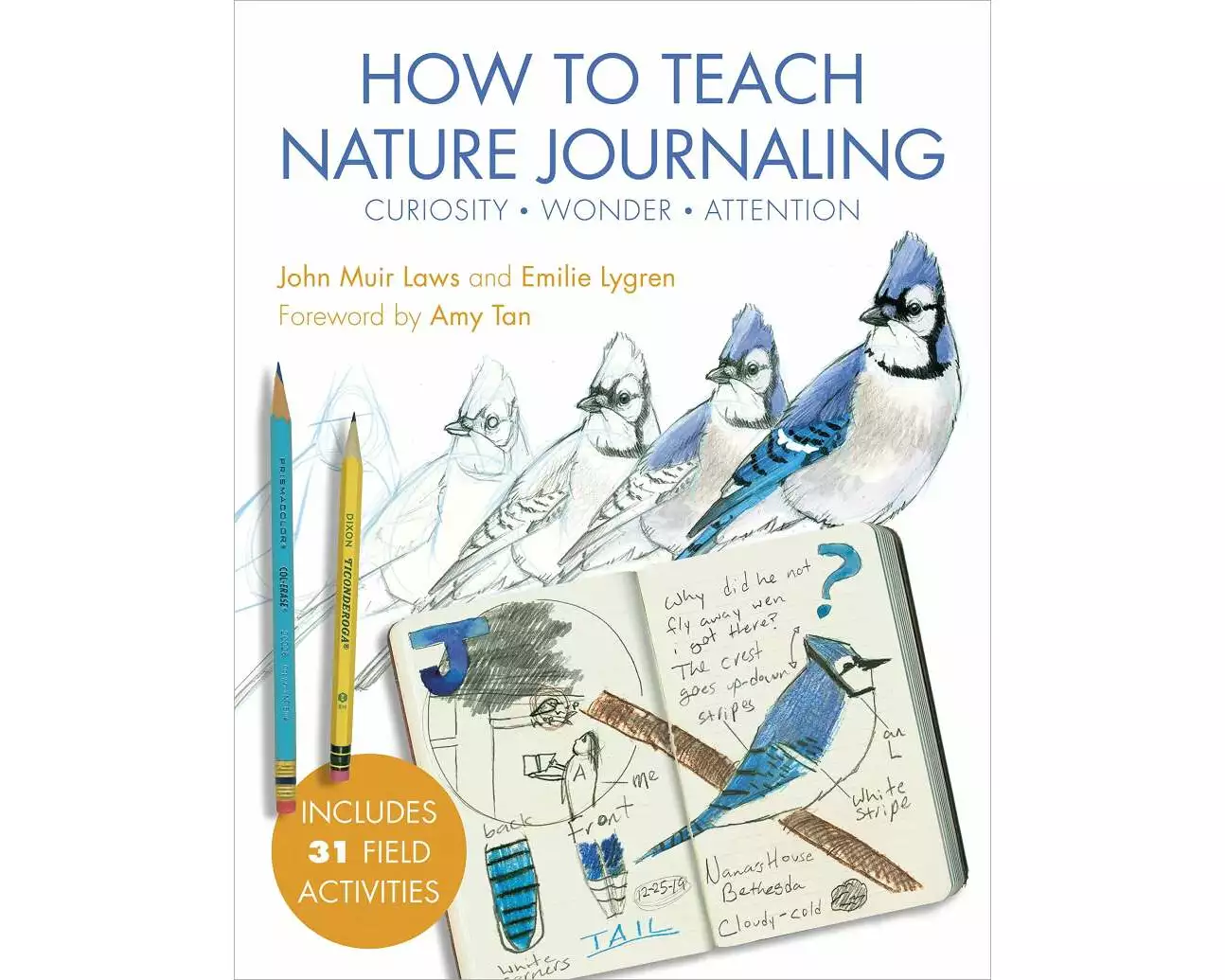
How to Teach Nature Journaling
Curiosity, Wonder, Attention
von Amy Tan, John Muir Laws, Emilie Lygren
- Unsere Artikel-Nr.
- G4NY926
Beschreibung
John Muir Laws' titles have sold over 200,000 copies, among them The Laws Field Guide to the Sierra Nevada. , The laws Guide to Drawing Birds. , and The Laws Guide to Nature Drawing and Journaling. Includes 31 activities that focus on engagement and experiential learningA progressive, interdisciplinary educational model with easy-to-implement rigorous learning ideas and activitiesAlso includes interviews and sidebars with students and teachers
Spezifikationen
| Sprache | Englisch |
|---|---|
| Autor | Amy Tan, John Muir Laws, Emilie Lygren |
| Thema | Kunst: Allgemein |
| Erscheinungsjahr | 2020 |
| Format | Buch (Softcover) |
| Anzahl Seiten | 296 |
Inhaltsverzeichnis
"TABLE OF CONTENTS
\r\nForeword by Amy Tan
\r\nINTRODUCTION
\r\nWhy We Teach Nature Journaling\r\n Why Nature Journaling?\r\n You Can Do This, and It Is Worth It\r\nMANAGING THE OUTDOOR CLASSROOM
\r\n Taking Students Outside\r\n How to Lead Journaling Activities\r\n Nature Journaling In Different Contexts\r\nTHE NATURE JOURNAL QUICKSTART GUIDE
\r\nNATURE JOURNALING ACTIVITIES\r\n GETTING STARTED: INTRODUCTORY JOURNALING TECHNIQUES AND ACTIVITIES\r\n Use Words, Pictures, and NumbersMix It Up\r\n I NOTICE, I WONDER, IT REMINDS ME OF\r\n MY SECRET PLANT\r\n TO EACH ITS OWN\r\n COMPARISON\r\n ZOOM IN, ZOOM OUT\r\nOBSERVATION AND NATURAL HISTORY\r\n Look Big, Look Small\r\n Make Comparisons and Study Categories\r\n Get Lost in Wonder\r\n COLLECTION OR FIELD GUIDE\r\n TIMELINE\r\n STRING SAFARI\r\n ANIMAL ENCOUNTERS\r\n SPECIES ACCOUNT\r\n FOREST KARAOKE: TRANSCRIBING BIRDSONG\r\n SOUNDSCAPE MAPS\r\n
INQUIRY, INVESTIGATION, AND SCIENTIFIC THINKING\r\n Intentional Curiosity and Inquiry\r\n The Crosscutting Concepts\r\n Who, What, Where, When, How, and Why\r\n International Baccalaureate Key Concepts\r\n How Do You Answer Your Questions?\r\n Ask Questions and Think Like a Scientist\r\n Practiced Precision \r\n Nature Puzzles\r\n Follow Curiosity Chains\r\n MYSTERIES AND EXPLANATIONS\r\n QUESTIONING QUESTIONS\r\n MAPPING\r\n LANDSCAPE CROSS SECTION\r\n PHENOMENON MODEL\r\n TEAM OBSERVATION
\r\nWORDS: ARTICULATED THOUGHT AND STORYTELLING\r\n Writing\r\n Find Poems within and around You\r\n Reflect, Connect, and Find Joy\r\n Practice Scientific Storytelling\r\n What Pictures Cannot Show\r\n WRITING TO OBSERVE, WRITING TO THINK\r\n EVENT COMIC\r\n EVENT MAP\r\n POETRY OF PLACE AND MOMENT\r\n SIT SPOT
\r\nPICTURES: DRAWING AND VISUAL THINKING\r\n Drawing\r\n Observational Drawing, Step-by-Step\r\n Building New Skills: Basic Drawing Exercises\r\n Drawing Tricks and Tips: Instruction for Students\r\n Page Structure and Layout\r\n THINK WITH PICTURES\r\n BALANCING FLEXIBILTY AND STRUCTURE\r\n LOOK, AND LOOK AGAIN\r\n INSIDE OUT\r\n NATURE BLUEPRINTS\r\n INFOGRAPHIC\r\n PHOTO, PENCIL, AND FOUND-OBJECT COLLAGE
\r\nNUMBERS: QUANTIFICATION AND MATHEMATICAL THINKING\r\n Numbers and Quantification\r\n Making Quantification Tool Kits\r\n SHOW WHERE THE NUMBERS COME FROM\r\n USE NUMBERS TO FIND THE PATTERN\r\n HIDDEN FIGURES\r\n BIODIVERSITY INVENTORY\r\n TIMED OBSERVATIONS\r\n CHANGE OVER TIME\r\n
INCORPORATING JOURNALING INTO LESSONS, FRAMEWORKS, AND ASSESSMENTS\r\n Journaling Over Time\r\n Developing Skills: Ideas, Practice, and Feedback\r\n Grading and Evaluation\r\n Evaluation Rubric\r\n From Activities to Longer Lessons\r\n Journaling and Education Standards\r\n Teaching Science and Inquiry: A Deeper Dive
\r\nFINAL THOUGHTS
\r\nAPPENDICES\r\n Tools and Materials\r\n Activity Summaries and Possible Phenomena\r\n NGSS Connections\r\n Evaluation Rubric\r\n Cut-and-Paste Nature Journal Essentials\r\n Cut-and-Paste Quantification Tool Kit
\r\nNotes
\r\nAcknowledgements
\r\nAbout the Naturalist Journal Contributors
\r\nAbout the Authors"
\r\nForeword by Amy Tan
\r\nINTRODUCTION
\r\n
\r\n
\r\nNATURE JOURNALING ACTIVITIES\r\n
INQUIRY, INVESTIGATION, AND SCIENTIFIC THINKING\r\n
\r\nWORDS: ARTICULATED THOUGHT AND STORYTELLING\r\n
\r\nPICTURES: DRAWING AND VISUAL THINKING\r\n
\r\nNUMBERS: QUANTIFICATION AND MATHEMATICAL THINKING\r\n
INCORPORATING JOURNALING INTO LESSONS, FRAMEWORKS, AND ASSESSMENTS\r\n
\r\nFINAL THOUGHTS
\r\nAPPENDICES\r\n
\r\nNotes
\r\nAcknowledgements
\r\nAbout the Naturalist Journal Contributors
\r\nAbout the Authors"
Leserkritik
“From the beginning of time, we have been connected to nature, but for the first time in history, that connection threatens to be broken for most of an entire generation and perhaps generations to come. In this book and this work, I find hope. Laws and Lygren have created a powerful and practical resource for teachers to help children and adults discover, explore, love, and protect the natural world around them. Nature is magic, and everyone needs it.”—Robert Bateman, artist and naturalist
“Engaging students in learning about nature is a compelling need in these turbulent times. Just as important is communicating clearly, precisely, and truthfully. Naturalists and educators John Muir Laws and Emilie Lygren help teachers achieve these goals with How to Teach Nature Journaling. This is a wonderful response to educators' request for meaningful ways to implement contemporary standards. The book is useful, full of activities, and manageable for classroom teachers.”—Rodger W. Bybee, Executive Director, BSCS Science Learning (Retired)
“Imagine if every teacher taught nature journaling, every student spent enough time outside to fill a journal each year, and our kids were becoming writers, artists, and scientists all at once. I’d send my kid to that school. Thanks to Emilie Lygren and Jack Laws, we now have the vision and the tools to make this our reality.”—Craig Strang, Associate Director of Lawrence Hall of Science
“The writing, the illustrations, the demonstration of an intentional, informative, and wonderfully educational approach to nature journal writing—it's all here. From field activities with clear examples to an inquiry-based approach to learning, this book is a gem for educators, first-time journalers, and for the experienced naturalist as well. It's art, it's writing, it's education, it's science, naturally so.”—José González, Founder of Latino Outdoors
“Here is a natural way for parents and teachers to integrate the beauty and mystery of nature into the lives of children. The book itself is a work of art.”—Richard Louv, author of Our Wild Calling and Last Child in the Woods
“Nature journaling is the single most valuable tool and skill a teacher can possess and use to move the Next Generation Science Standards and environmental literacy forward in their school. You need to do this!”—Rob Wade, Science & Outdoor Education Coordinator, Plumas Unified School District/Plumas County of Education
“This book beautifully demonstrates how nature journaling is a valuable, multidimensional approach to science. Through this work, students build neural pathways that enable different brain regions to communicate with each other, resulting in more flexible thinking and creative problem solving in all areas of life. This approach to nature journaling also offers students an excellent way to learn and practice a growth mindset through nature and science.”—Jo Boaler, Professor of Education and Equity, Stanford University; co-founder and faculty director of youcubed.org; and author of several books including Mathematical Mindsets and Limitless Mind
“Charlotte Mason said that 'where science does not teach a child to wonder and admire it has perhaps no educative value.' John Muir Laws and Emilie Lygren have filled their book with the tools of nature journaling that can help us all get outdoors to wonder at and admire the nature around us. What a gift their book is!”—J. Carroll Smith, EdD, Founder of the Charlotte Mason Institute, Professor of Education (Retired)
“In How to Teach Nature Journaling, educators get best practices for facilitating intentional and inclusive strategies for nature journaling with students. This can spark a lifelong wonder of the natural world.”—Arvolyn Hill, Coordinator of Family Programs, Children's Adventure Garden at the New York Botanical Garden
“How to Teach Nature Journaling offers step-by-step processes to reach all learners through shared experience. This can be a transformative way for students to learn to communicate and express how they view the natural world.”—Michelle Peres, Environmental Educator, NatureBridge
Bewertungen
Produkt bewertenFür dieses Produkt liegt noch keine Bewertung vor. Wenn Sie es gekauft haben, teilen Sie gerne Ihre Erfahrung.
Zahlungsarten


Rechnung (Einzahlungsschein mit QR-Code), Twint, Kreditkarte, PostFinance, Apple, Google oder Samsung Pay.
Versand
Kostenlos: Schweiz & Liechtenstein
Rückgabe
30 Tage Rückgaberecht
Sie können das Produkt innerhalb von 30 Wochentagen ohne Angabe von Gründen zurücksenden, sofern es unbeschädigt und in der Originalverpackung ist.
Weitere Hinweise finden Sie in unseren AGB unter D.1.