
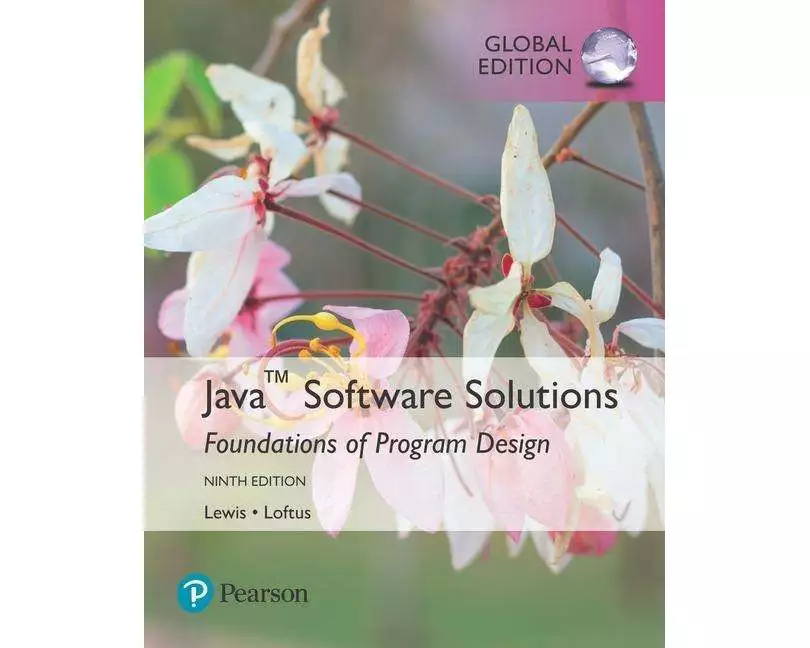
Java Software Solutions, Global Edition
von William Loftus, John Lewis
- Verlag
- Pearson
- Unsere Artikel-Nr.
- 54VRY44
Beschreibung
Spezifikationen
| Sprache | Englisch |
|---|---|
| Autor | William Loftus, John Lewis |
| Thema | Softwareentwicklung: Programmiersprachen |
| Auflage | 9 |
| Erscheinungsjahr | 2018 |
| Format | Buch (Softcover) |
| Anzahl Seiten | 800 |
Inhaltsverzeichnis
1. Introduction<\/b><\/p>
1.1 Computer Processing<\/p>
1.2 Hardware Components<\/p>
1.3 Networks<\/p>
1.4 The Java Programming Language<\/p>
1.5 Programming Development<\/p>
1.6 Object-Oriented Programming<\/p>
<\/p>
2. Data and Expressions<\/b><\/p>
2.1 Character Strings<\/p>
2.2 Variables and Assignment<\/p>
2.3 Primitive Data Types<\/p>
2.4 Expressions<\/p>
2.5 Data Conversion<\/p>
Software Failure: NASA Mars Climate Orbiter and Polar Lander<\/p>
<\/p>
3. Using Classes and Objects<\/b><\/p>
3.1 Creating Objects<\/p>
3.2 The String Class<\/p>
3.3 Packages<\/p>
3.4 The Random Class<\/p>
3.5 The Math Class<\/p>
3.6 Formatting Output<\/p>
3.7 Enumerated Types<\/p>
3.8 Wrapper Classes<\/p>
3.9 Introduction to JavaFX<\/p>
3.10 Basic Shapes<\/p>
3.11 Representing Colors<\/p>
<\/p>
4. Writing Classes<\/b><\/p>
4.1 Classes and Objects Revisited<\/p>
4.2 Anatomy of a Class<\/p>
4.3 Encapsulation<\/p>
4.4 Anatomy of a Method<\/p>
4.5 Constructors Revisited<\/p>
4.6 Arcs<\/p>
4.7 Images<\/p>
4.8 Graphical User Interfaces<\/p>
4.9 Text Fields<\/p>
Software Failure: Denver Airport Baggage Handling System<\/p>
<\/p>
5. Conditionals and Loops<\/b><\/p>
5.1 Boolean Expressions<\/p>
5.2 The If Statement<\/p>
5.3 Comparing Data<\/p>
5.4 The While Statement<\/p>
5.5 Iterators<\/p>
5.6 The ArrayList Class<\/p>
5.7 Determining Event Sources<\/p>
5.8 Managing Fonts<\/p>
5.9 Checkboxes<\/p>
5.10 Radio Buttons<\/p>
Software Failure: Therac-25<\/p>
<\/p>
6. More Conditionals and Loops<\/b><\/p>
6.1 The Switch Statement<\/p>
6.2 The Conditional Operator<\/p>
6.3 The Do Statement<\/p>
6.4 The For Statement<\/p>
6.5 Using Loops and Conditionals with Graphics<\/p>
6.6 Graphic Transformations<\/p>
<\/p>
7. Object-Oriented Design<\/b><\/p>
7.1 Software Development Activities<\/p>
7.2 Identifying Classes and Objects<\/p>
7.3. Static Class Members<\/p>
7.4 Class Relationships<\/p>
7.5 Interfaces<\/p>
7.6 Enumerated Types Revisited<\/p>
7.7 Method Design<\/p>
7.8 Method Overloading<\/p>
7.9 Testing<\/p>
7.10 GUI Design<\/p>
7.11 Key Events<\/p>
Software Failure: 2003 Northeast Blackout<\/p>
<\/p>
8. Arrays<\/b><\/p>
8.1 Array Elements<\/p>
8.2 Declaring and Using Arrays<\/p>
8.3 Arrays of Objects<\/p>
8.4 Command-Line Arguments<\/p>
8.5 Variable Length Parameter Lists<\/p>
8.6 Two-Dimensional Arrays<\/p>
8.7 Polygons and Polylines<\/p>
8.8 An Array of Color Objects<\/p>
8.9 Choice Boxes<\/p>
Software Failure: LA Air Traffic Control<\/p>
<\/p>
9. Inheritance<\/b><\/p>
9.1 Creating Subclasses<\/p>
9.2 Overriding Methods<\/p>
9.3 Class Hierarchies<\/p>
9.4 Visibility<\/p>
9.5 Designing for Inheritance<\/p>
9.6 Inheritance in JavaFX<\/p>
9.7 Color and Date Pickers<\/p>
9.8 Dialog Boxes<\/p>
Software Failure: Ariane 5 Flight 501<\/p>
<\/p>
10. Polymorphism<\/b><\/p>
10.1 Late Binding<\/p>
10.2 Polymorphism via Inheritance<\/p>
10.3 Polymorphism vis Interfaces<\/p>
10.4 Sorting<\/p>
10.5 Searching<\/p>
10.6 Designing for Polymorphism<\/p>
10.7 Properties<\/p>
10.8 Sliders<\/p>
10.9 Spinners<\/p>
<\/p>
11. Exceptions<\/b><\/p>
11.1 Exception Handling<\/p>
11.2 Uncaught Exceptions<\/p>
11.3 The Try-Catch Statement<\/p>
11.4 Exception Propagation<\/p>
11.5 The Exception Class Hierarchy<\/p>
11.6 I\/O Exceptions<\/p>
11.7 Tool Tips and Disabling Controls<\/p>
11.8 Scroll Panes<\/p>
11.9 Split Panes and List Views<\/p>
<\/p>
12. Recursion<\/b><\/p>
12.1 Recursive Thinking<\/p>
12.2 Recursive Programming<\/p>
12.3 Using Recursion<\/p>
12.4 Tiled Images<\/p>
12.5 Fractals<\/p>
<\/p>
13. Collections<\/b><\/p>
13.1 Collections and Data Structures<\/p>
13.2 Dynamic Representations<\/p>
13.3 Linear Collections<\/p>
13.4 Non-Linear Data Structures<\/p>
13.5 The Java Collections API<\/p>
<\/p>
Appendix A: Glossary<\/p>
Appendix B: Number Systems<\/p>
Appendix C: The Unicode Character Set<\/p>
Appendix D: Java Operators<\/p>
Appendix E: Java Modifiers<\/p>
Appendix F: Java Coding Guidelines<\/p>
Appendix G: JavaFX Layout Panes<\/p>
Appendix H: JavaFX Scene Builder<\/p>
Appendix I: Regular Expressions<\/p>
Appendix J: Javadoc Documentation Generator<\/p>
Appendix K: Java Syntax<\/p>
Appendix L: Answers to Self-Review Questions<\/p>
Index<\/p>"
Bewertungen
Produkt bewertenFür dieses Produkt liegt noch keine Bewertung vor. Wenn Sie es gekauft haben, teilen Sie gerne Ihre Erfahrung.
Zahlungsarten


Rechnung (Einzahlungsschein mit QR-Code), Twint, Kreditkarte, PostFinance, Apple, Google oder Samsung Pay.
Versand
Kostenlos: Schweiz & Liechtenstein
Rückgabe
30 Tage Rückgaberecht
Sie können das Produkt innerhalb von 30 Wochentagen ohne Angabe von Gründen zurücksenden, sofern es unbeschädigt und in der Originalverpackung ist.
Weitere Hinweise finden Sie in unseren AGB unter D.1.