
Auf Lager:1Buch (Softcover): Fachbuch
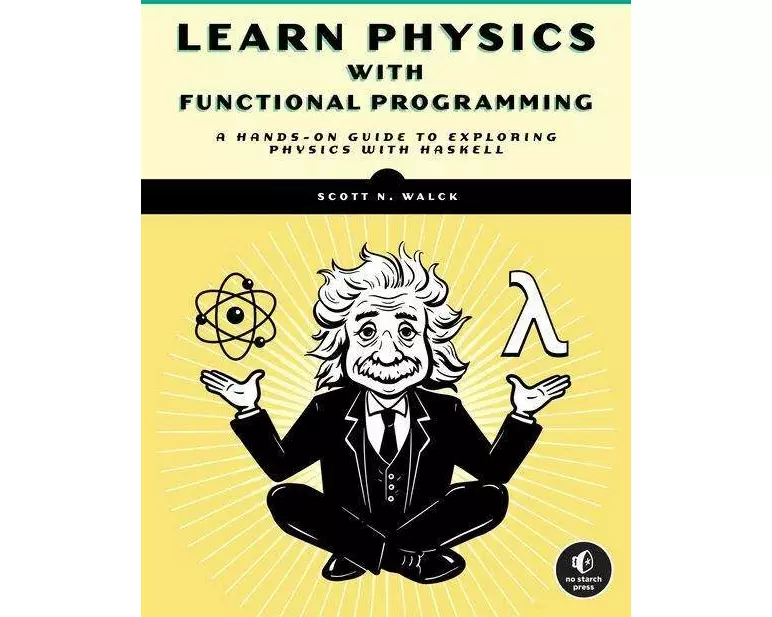
Learn Physics with Functional Programming
A Hands-on Guide to Exploring Physics with Haskell
von Scott N. Walck
- Verlag
- Penguin Random House
- Unsere Artikel-Nr.
- 7RRG29Q
Beschreibung
Deepen your understanding of physics by learning to use the Haskell functional programming language. Learn Physics with Functional Programming. is your key to unlocking the mysteries of theoretical physics by coding the underlying math in Haskell. You’ll use Haskell’s type system to check that your code makes sense as you deepen your understanding of Newtonian mechanics and electromagnetic theory, including how to describe and calculate electric and magnetic fields. As you work your way through the book’s numerous examples and exercises, you’ll learn how to:Encode vectors, derivatives, integrals, scalar fields, vector fields, and differential equations. Express fundamental physical principles using the logic of Haskell’s type system to clarify Newton’s second law, Coulomb’s law, the Biot-Savart law, and the Maxwell equations. Use higher-order functions to express numerical integration and approximation methods, such as the Euler method and the finite-difference time-domain (FDTD) method. Create graphs, models, and animations of physical scenarios like colliding billiard balls, waves in a guitar string, and a proton in a magnetic field. Whether you’re using this book as a core textbook for a computational physics course or for self-study, Learn Physics with Functional Programming. will teach you how to use the power of functional programming to explore the beautiful ideas of theoretical physics.
Spezifikationen
| Sprache | Englisch |
|---|---|
| Autor | Scott N. Walck |
| Thema | Softwareentwicklung: Programmiersprachen |
| Erscheinungsjahr | 2023 |
| Format | Buch (Softcover) |
| Anzahl Seiten | 648 |
Inhaltsverzeichnis
"Acknowledgments
Introduction
Part I: A Haskell Primer for Physicists
<\/b>Chapter 1: Calculating with Haskell
Chapter 2: Writing Basic Functions
Chapter 3: Types and Entities
Chapter 4: Describing Motion
Chapter 5: Working with Lists
Chapter 6: Higher-Order Functions
Chapter 7: Graphing Functions
Chapter 8: Type Classes
Chapter 9: Tuples and Type Constructors
Chapter 10: Describing Motion in Three Dimensions
Chapter 11: Creating Graphs
Chapter 12: Creating Stand-Alone Programs
Chapter 13: Creating 2D and 3D Animations
Part II: Expressing Newtonian Mechanics and Solving Problems
<\/b>Chapter 14: Newton’s Second Law and Differential Equations
Chapter 15: Mechanics in One Dimension
Chapter 16: Mechanics in Three Dimensions
Chapter 17: Satellite, Projectile, and Proton Motion
Chapter 18: A Very Short Primer on Relativity
Chapter 19: Interacting Particles
Chapter 20: Springs, Billiard Balls, and a Guitar String
Part III: Expressing Electromagnetic Theory and Solving Problems
<\/b>Chapter 21: Electricity
Chapter 22: Coordinate Systems and Fields
Chapter 23: Curves, Surfaces, and Volumes
Chapter 24: Electric Charge
Chapter 25: Electric Field
Chapter 26: Electric Current
Chapter 27: Magnetic Field
Chapter 28: The Lorentz Force Law
Chapter 29: The Maxwell Equations
Appendix: Installing Haskell
Bibliography
Index"
Bewertungen
Produkt bewertenFür dieses Produkt liegt noch keine Bewertung vor. Wenn Sie es gekauft haben, teilen Sie gerne Ihre Erfahrung.
Zahlungsarten


Rechnung (Einzahlungsschein mit QR-Code), Twint, Kreditkarte, PostFinance, Apple, Google oder Samsung Pay.
Versand
Kostenlos: Schweiz & Liechtenstein
Rückgabe
30 Tage Rückgaberecht
Sie können das Produkt innerhalb von 30 Wochentagen ohne Angabe von Gründen zurücksenden, sofern es unbeschädigt und in der Originalverpackung ist.
Weitere Hinweise finden Sie in unseren AGB unter D.1.