
Auf Lager:2Buch (Softcover): Fachbuch
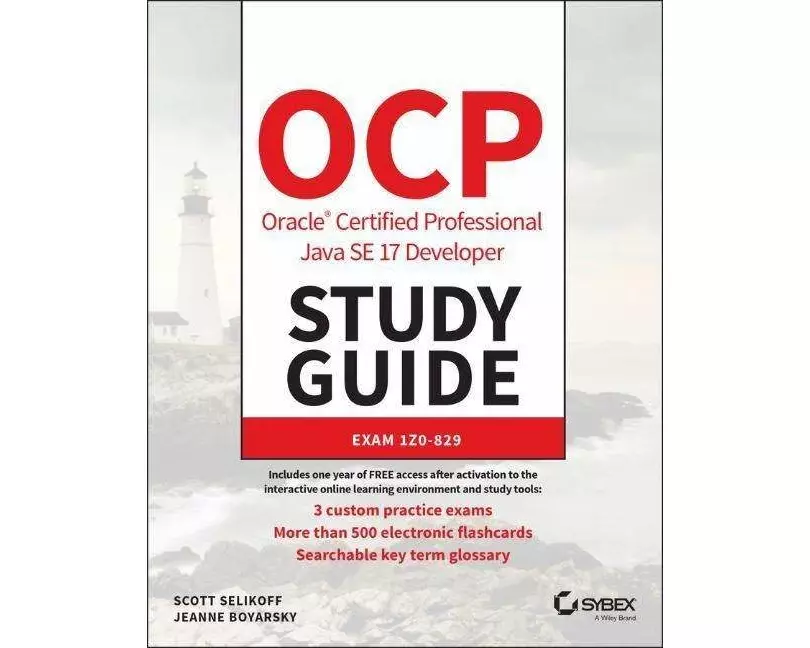
OCP Oracle Certified Professional Java SE 17 Developer Study Guide
Exam 1Z0-829
von Jeanne Boyarsky, Scott Selikoff
- Verlag
- John Wiley & Sons
- Unsere Artikel-Nr.
- W7W69PG
Beschreibung
An effective and practical study aid to the new OCP Java SE 17 Developer certification exam In the OCP Oracle Certified Professional Java SE 17 Developer Study Guide: Exam 1Z0-829, you'll find accessible and essential test prep material for the in-demand and practical OCP Java SE 17 Developer certification. Providing comprehensive coverage of all OCP Java SE 17 exam objectives and competencies, the Study Guide offers you access to all the skills and knowledge you'll need to succeed on the test and in the field as a new or experienced Java developer. This book provides material on records, sealed classes, text blocks, dates, streams, controlling program flow, using the Java object-oriented approach, handling exceptions, working with arrays and collections, and more. You'll also get: Intuitively organized information that aligns with the competencies tested on the exam and those required by real-world Java developers Opportunities to practice and develop skills that remain in high demand in the IT industry Access to the Sybex online learning center, with chapter review questions, full-length practice exams, hundreds of electronic flashcards, and a glossary of key terms Perfect for anyone prepping for the brand-new OCP Java SE 17 credential, OCP Oracle Certified Professional Java SE 17 Developer Study Guide: Exam 1Z0-829 is also a can't-miss reference for practicing and aspiring Java developers seeking to learn or reinforce their foundational skills in Java programming and improve their performance on the job.
Spezifikationen
| Sprache | Englisch |
|---|---|
| Autor | Jeanne Boyarsky, Scott Selikoff |
| Thema | Softwareentwicklung: Programmiersprachen |
| Auflage | 1 |
| Erscheinungsjahr | 2022 |
| Format | Buch (Softcover) |
| Anzahl Seiten | 1056 |
Inhaltsverzeichnis
"Introduction xxiii\n\nAssessment Test xlv\n\nChapter 1 Building Blocks 1\n\nLearning about the Environment 2\n\nMajor Components of Java 2\n\nDownloading a JDK 3\n\nUnderstanding the Class Structure 4\n\nFields and Methods 4\n\nComments 5\n\nClasses and Source Files 7\n\nWriting a main() Method 8\n\nCreating a main() Method 8\n\nPassing Parameters to a Java Program 9\n\nUnderstanding Package Declarations and Imports 11\n\nPackages 12\n\nWildcards 13\n\nRedundant Imports 13\n\nNaming Conflicts 15\n\nCreating a New Package 16\n\nCompiling and Running Code with Packages 16\n\nCompiling to Another Directory 18\n\nCompiling with JAR Files 20\n\nCreating a JAR File 20\n\nOrdering Elements in a Class 21\n\nCreating Objects 23\n\nCalling Constructors 23\n\nReading and Writing Member Fields 24\n\nExecuting Instance Initializer Blocks 24\n\nFollowing the Order of Initialization 25\n\nUnderstanding Data Types 26\n\nUsing Primitive Types 27\n\nUsing Reference Types 29\n\nDistinguishing between Primitives and Reference Types 30\n\nCreating Wrapper Classes 31\n\nDefining Text Blocks 32\n\nDeclaring Variables 34\n\nIdentifying Identifiers 35\n\nDeclaring Multiple Variables 36\n\nInitializing Variables 38\n\nCreating Local Variables 38\n\nPassing Constructor and Method Parameters 40\n\nDefining Instance and Class Variables 41\n\nInferring the Type with var 41\n\nManaging Variable Scope 45\n\nLimiting Scope 45\n\nTracing Scope 46\n\nApplying Scope to Classes 47\n\nReviewing Scope 48\n\nDestroying Objects 48\n\nUnderstanding Garbage Collection 48\n\nTracing Eligibility 49\n\nSummary 51\n\nExam Essentials 52\n\nReview Questions 54\n\nChapter 2 Operators 65\n\nUnderstanding Java Operators 66\n\nTypes of Operators 66\n\nOperator Precedence 67\n\nApplying Unary Operators 69\n\nComplement and Negation Operators 70\n\nIncrement and Decrement Operators 71\n\nWorking with Binary Arithmetic Operators 72\n\nArithmetic Operators 72\n\nNumeric Promotion 75\n\nAssigning Values 77\n\nAssignment Operator 77\n\nCasting Values 77\n\nCompound Assignment Operators 81\n\nReturn Value of Assignment Operators 82\n\nComparing Values 83\n\nEquality Operators 83\n\nRelational Operators 84\n\nLogical Operators 87\n\nConditional Operators 88\n\nMaking Decisions with the Ternary Operator 90\n\nSummary 92\n\nExam Essentials 92\n\nReview Questions 94\n\nChapter 3 Making Decisions 101\n\nCreating Decision-Making\n\nStatements 102\n\nStatements and Blocks 102\n\nThe if Statement 103\n\nThe else Statement 104\n\nShortening Code with Pattern Matching 106\n\nApplying switch Statements 110\n\nThe switch Statement 110\n\nThe switch Expression 115\n\nWriting while Loops 121\n\nThe while Statement 121\n\nThe do\/while Statement 123\n\nInfinite Loops 123\n\nConstructing for Loops 124\n\nThe for Loop 124\n\nThe for-each\n\nLoop 129\n\nControlling Flow with Branching 131\n\nNested Loops 131\n\nAdding Optional Labels 132\n\nThe break Statement 133\n\nThe continue Statement 135\n\nThe return Statement 137\n\nUnreachable Code 138\n\nReviewing Branching 139\n\nSummary 139\n\nExam Essentials 140\n\nReview Questions 142\n\nChapter 4 Core APIs 155\n\nCreating and Manipulating Strings 156\n\nConcatenating 157\n\nImportant String Methods 158\n\nMethod Chaining 169\n\nUsing the StringBuilder Class 170\n\nMutability and Chaining 171\n\nCreating a StringBuilder 172\n\nImportant StringBuilder Methods 172\n\nUnderstanding Equality 175\n\nComparing equals() and == 175\n\nThe String Pool 176\n\nUnderstanding Arrays 178\n\nCreating an Array of Primitives 179\n\nCreating an Array with Reference Variables 180\n\nUsing an Array 182\n\nSorting 183\n\nSearching 184\n\nComparing 185\n\nUsing Methods with Varargs 187\n\nWorking with Multidimensional Arrays 188\n\nCalculating with Math APIs 190\n\nFinding the Minimum and Maximum 190\n\nRounding Numbers 191\n\nDetermining the Ceiling and Floor 191\n\nCalculating Exponents 192\n\nGenerating Random Numbers 192\n\nWorking with Dates and Times 192\n\nCreating Dates and Times 193\n\nManipulating Dates and Times 197\n\nWorking with Periods 199\n\nWorking with Durations 202\n\nPeriod vs. Duration 204\n\nWorking with Instants 205\n\nAccounting for Daylight Saving Time 206\n\nSummary 208\n\nExam Essentials 209\n\nReview Questions 210\n\nChapter 5 Methods 219\n\nDesigning Methods 220\n\nAccess Modifiers 221\n\nOptional Specifiers 222\n\nReturn Type 224\n\nMethod Name 226\n\nParameter List 226\n\nMethod Signature 227\n\nException List 227\n\nMethod Body 228\n\nDeclaring Local and Instance Variables 228\n\nLocal Variable Modifiers 229\n\nEffectively Final Variables 230\n\nInstance Variable Modifiers 231\n\nWorking with Varargs 232\n\nCreating Methods with Varargs 232\n\nCalling Methods with Varargs 233\n\nAccessing Elements of a Vararg 234\n\nUsing Varargs with Other Method Parameters 234\n\nApplying Access Modifiers 235\n\nPrivate Access 235\n\nPackage Access 236\n\nProtected Access 237\n\nPublic Access 242\n\nReviewing Access Modifiers 242\n\nAccessing static Data 243\n\nDesigning static Methods and Variables 243\n\nAccessing a static Variable or Method 244\n\nClass vs. Instance Membership 245\n\nstatic Variable Modifiers 248\n\nstatic Initializers 250\n\nstatic Imports 251\n\nPassing Data among Methods 253\n\nPassing Objects 253\n\nReturning Objects 255\n\nAutoboxing and Unboxing Variables 256\n\nOverloading Methods 258\n\nReference Types 259\n\nPrimitives 260\n\nAutoboxing 261\n\nArrays 261\n\nVarargs 261\n\nPutting It All Together 262\n\nSummary 263\n\nExam Essentials 264\n\nReview Questions 265\n\nChapter 6 Class Design 275\n\nUnderstanding Inheritance 276\n\nDeclaring a Subclass 276\n\nClass Modifiers 278\n\nSingle vs. Multiple Inheritance 279\n\nInheriting Object 279\n\nCreating Classes 281\n\nExtending a Class 281\n\nApplying Class Access Modifiers 282\n\nAccessing the this Reference 283\n\nCalling the super Reference 284\n\nDeclaring Constructors 286\n\nCreating a Constructor 286\n\nThe Default Constructor 287\n\nCalling Overloaded Constructors with this() 289\n\nCalling Parent Constructors with super() 292\n\nInitializing Objects 297\n\nInitializing Classes 297\n\nInitializing final Fields 298\n\nInitializing Instances 300\n\nInheriting Members 304\n\nOverriding a Method 305\n\nRedeclaring private Methods 311\n\nHiding Static Methods 311\n\nHiding Variables 313\n\nWriting final Methods 314\n\nCreating Abstract Classes 315\n\nIntroducing Abstract Classes 315\n\nDeclaring Abstract Methods 317\n\nCreating a Concrete Class 318\n\nCreating Constructors in Abstract Classes 320\n\nSpotting Invalid Declarations 321\n\nCreating Immutable Objects 323\n\nDeclaring an Immutable Class 323\n\nPerforming a Defensive Copy 325\n\nSummary 326\n\nExam Essentials 327\n\nReview Questions 330\n\nChapter 7 Beyond Classes 345\n\nImplementing Interfaces 346\n\nDeclaring and Using an Interface 346\n\nExtending an Interface 348\n\nInheriting an Interface 349\n\nInserting Implicit Modifiers 351\n\nDeclaring Concrete Interface Methods 353\n\nWorking with Enums 361\n\nCreating Simple Enums 361\n\nUsing Enums in switch Statements 363\n\nAdding Constructors, Fields, and Methods 364\n\nSealing Classes 367\n\nDeclaring a Sealed Class 367\n\nCompiling Sealed Classes 368\n\nSpecifying the Subclass Modifier 369\n\nOmitting the permits Clause 370\n\nSealing Interfaces 372\n\nReviewing Sealed Class Rules 372\n\nEncapsulating Data with Records 373\n\nUnderstanding Encapsulation 374\n\nApplying Records 375\n\nUnderstanding Record Immutability 377\n\nDeclaring Constructors 378\n\nCustomizing Records 381\n\nCreating Nested Classes 382\n\nDeclaring an Inner Class 382\n\nCreating a static Nested Class 386\n\nWriting a Local Class 387\n\nDefining an Anonymous Class 389\n\nReviewing Nested Classes 391\n\nUnderstanding Polymorphism 392\n\nObject vs. Reference 393\n\nCasting Objects 395\n\nThe instanceof Operator 397\n\nPolymorphism and Method Overriding 397\n\nOverriding vs. Hiding Members 399\n\nSummary 401\n\nExam Essentials 402\n\nReview Questions 404\n\nChapter 8 Lambdas and Functional Interfaces 419\n\nWriting Simple Lambdas 420\n\nLooking at a Lambda Example 420\n\nLearning Lambda Syntax 422\n\nCoding Functional Interfaces 426\n\nDefining a Functional Interface 426\n\nAdding Object Methods 427\n\nUsing Method References 429\n\nCalling static Methods 430\n\nCalling Instance Methods on a Particular Object 430\n\nCalling Instance Methods on a Parameter 432\n\nCalling Constructors 433\n\nReviewing Method References 433\n\nWorking with Built-in\n\nFunctional Interfaces 434\n\nImplementing Supplier 435\n\nImplementing Consumer and BiConsumer 436\n\nImplementing Predicate and BiPredicate 438\n\nImplementing Function and BiFunction 439\n\nImplementing UnaryOperator and BinaryOperator 440\n\nChecking Functional Interfaces 441\n\nUsing Convenience Methods on Functional Interfaces 442\n\nLearning the Functional Interfaces for Primitives 443\n\nWorking with Variables in Lambdas 445\n\nListing Parameters 446\n\nUsing Local Variables inside a Lambda Body 448\n\nReferencing Variables from the Lambda Body 449\n\nSummary 450\n\nExam Essentials 451\n\nReview Questions 452\n\nChapter 9 Collections and Generics 463\n\nUsing Common Collection APIs 464\n\nUsing the Diamond Operator 465\n\nAdding Data 466\n\nRemoving Data 466\n\nCounting Elements 467\n\nClearing the Collection 467\n\nCheck Contents 468\n\nRemoving with Conditions 468\n\nIterating 469\n\nDetermining Equality 470\n\nUsing the List Interface 471\n\nComparing List Implementations 472\n\nCreating a List with a Factory 472\n\nCreating a List with a Constructor 473\n\nWorking with List Methods 474\n\nConverting from List to an Array 476\n\nUsing the Set Interface 477\n\nComparing Set Implementations 477\n\nWorking with Set Methods 478\n\nUsing the Queue and Deque Interfaces 479\n\nComparing Deque Implementations 480\n\nWorking with Queue and Deque Methods 480\n\nUsing the Map Interface 483\n\nComparing Map Implementations 484\n\nWorking with Map Methods 484\n\nCalling Basic Methods 486\n\nIterating through a Map 487\n\nGetting Values Safely 487\n\nReplacing Values 488\n\nPutting if Absent 488\n\nMerging Data 488\n\nComparing Collection Types 490\n\nSorting Data 492\n\nCreating a Comparable Class 492\n\nComparing Data with a Comparator 496\n\nComparing Comparable and Comparator 497\n\nComparing Multiple Fields 498\n\nSorting and Searching 500\n\nSorting a List 503\n\nWorking with Generics 503\n\nCreating Generic Classes 504\n\nUnderstanding Type Erasure 506\n\nImplementing Generic Interfaces 509\n\nWriting Generic Methods 510\n\nCreating a Generic Record 512\n\nBounding Generic Types 512\n\nPutting It All Together 517\n\nSummary 519\n\nExam Essentials 520\n\nReview Questions 521\n\nChapter 10 Streams 531\n\nReturning an Optional 532\n\nCreating an Optional 533\n\nDealing with an Empty Optional 534\n\nUsing Streams 536\n\nUnderstanding the Pipeline Flow 536\n\nCreating Stream Sources 539\n\nUsing Common Terminal Operations 541\n\nUsing Common Intermediate Operations 549\n\nPutting Together the Pipeline 553\n\nWorking with Primitive Streams 557\n\nCreating Primitive Streams 557\n\nMapping Streams 560\n\nUsing Optional with Primitive Streams 562\n\nSummarizing Statistics 564\n\nWorking with Advanced Stream Pipeline Concepts 565\n\nLinking Streams to the Underlying Data 565\n\nChaining Optionals 566\n\nUsing a Spliterator 569\n\nCollecting Results 570\n\nSummary 578\n\nExam Essentials 579\n\nReview Questions 581\n\nChapter 11 Exceptions and Localization 591\n\nUnderstanding Exceptions 592\n\nThe Role of Exceptions 592\n\nUnderstanding Exception Types 593\n\nThrowing an Exception 596\n\nCalling Methods That Throw Exceptions 598\n\nOverriding Methods with Exceptions 599\n\nPrinting an Exception 600\n\nRecognizing Exception Classes 600\n\nRuntimeException Classes 601\n\nChecked Exception Classes 604\n\nError Classes 605\n\nHandling Exceptions 605\n\nUsing try and catch Statements 606\n\nChaining catch Blocks 607\n\nApplying a Multi-catch\n\nBlock 609\n\nAdding a finally Block 611\n\nAutomating Resource Management 615\n\nIntroducing Try-with-Resources 615\n\nBasics of Try-with-Resources 616\n\nApplying Effectively Final 620\n\nUnderstanding Suppressed Exceptions 621\n\nFormatting Values 624\n\nFormatting Numbers 624\n\nFormatting Dates and Times 625\n\nCustomizing the Date\/Time Format 626\n\nSupporting Internationalization and Localization 629\n\nPicking a Locale 630\n\nLocalizing Numbers 632\n\nLocalizing Dates 637\n\nSpecifying a Locale Category 638\n\nLoading Properties with Resource Bundles 639\n\nCreating a Resource Bundle 640\n\nPicking a Resource Bundle 641\n\nSelecting Resource Bundle Values 643\n\nFormatting Messages 645\n\nUsing the Properties Class 645\n\nSummary 646\n\nExam Essentials 647\n\nReview Questions 648\n\nChapter 12 Modules 661\n\nIntroducing Modules 662\n\nExploring a Module 663\n\nBenefits of Modules 664\n\nCreating and Running a Modular Program 664\n\nCreating the Files 665\n\nCompiling Our First Module 666\n\nRunning Our First Module 668\n\nPackaging Our First Module 669\n\nUpdating Our Example for Multiple Modules 669\n\nUpdating the Feeding Module 670\n\nCreating a Care Module 670\n\nCreating the Talks Module 672\n\nCreating the Staff Module 674\n\nDiving into the Module Declaration 675\n\nExporting a Package 676\n\nRequiring a Module Transitively 677\n\nOpening a Package 679\n\nCreating a Service 680\n\nDeclaring the Service Provider Interface 681\n\nCreating a Service Locator 682\n\nInvoking from a Consumer 684\n\nAdding a Service Provider 685\n\nReviewing Directives and Services 686\n\nDiscovering Modules 687\n\nIdentifying Built-in Modules 688\n\nGetting Details with java 690\n\nDescribing with jar 693\n\nLearning about Dependencies with jdeps 693\n\nUsing the --jdk-internals Flag 695\n\nUsing Module Files with jmod 696\n\nCreating Java Runtimes with jlink 696\n\nReviewing Command-Line Options 697\n\nComparing Types of Modules 700\n\nNamed Modules 701\n\nAutomatic Modules 701\n\nUnnamed Modules 704\n\nReviewing Module Types 704\n\nMigrating an Application 704\n\nDetermining the Order 705\n\nExploring a Bottom-Up Migration Strategy 706\n\nExploring a Top-Down\n\nMigration Strategy 707\n\nSplitting a Big Project into Modules 709\n\nFailing to Compile with a Cyclic Dependency 709\n\nSummary 711\n\nExam Essentials 712\n\nReview Questions 713\n\nChapter 13 Concurrency 721\n\nIntroducing Threads 722\n\nUnderstanding Thread Concurrency 723\n\nCreating a Thread 724\n\nDistinguishing Thread Types 725\n\nManaging a Thread's Life Cycle 727\n\nPolling with Sleep 727\n\nInterrupting a Thread 729\n\nCreating Threads with the Concurrency API 730\n\nIntroducing the Single-Thread Executor 730\n\nShutting Down a Thread Executor 731\n\nSubmitting Tasks 732\n\nWaiting for Results 733\n\nScheduling Tasks 737\n\nIncreasing Concurrency with Pools 739\n\nWriting Thread-Safe Code 740\n\nUnderstanding Thread-Safety 740\n\nAccessing Data with volatile 741\n\nProtecting Data with Atomic Classes 742\n\nImproving Access with Synchronized Blocks 744\n\nSynchronizing on Methods 746\n\nUnderstanding the Lock Framework 747\n\nOrchestrating Tasks with a CyclicBarrier 751\n\nUsing Concurrent Collections 754\n\nUnderstanding Memory Consistency Errors 754\n\nWorking with Concurrent Classes 755\n\nObtaining Synchronized Collections 757\n\nIdentifying Threading Problems 758\n\nUnderstanding Liveness 758\n\nManaging Race Conditions 761\n\nWorking with Parallel Streams 761\n\nCreating Parallel Streams 762\n\nPerforming a Parallel Decomposition 762\n\nProcessing Parallel Reductions 764\n\nSummary 770\n\nExam Essentials 770\n\nReview Questions 772\n\nChapter 14 I\/O 785\n\nReferencing Files and Directories 786\n\nConceptualizing the File System 786\n\nCreating a File or Path 789\n\nOperating on File and Path 793\n\nUsing Shared Functionality 793\n\nHandling Methods That Declare IOException 797\n\nProviding NIO.2 Optional Parameters 797\n\nInteracting with NIO.2 Paths 799\n\nCreating, Moving, and Deleting Files and Directories 805\n\nComparing Files with isSameFile() and mismatch() 809\n\nIntroducing I\/O Streams 811\n\nUnderstanding I\/O Stream Fundamentals 811\n\nLearning I\/O Stream Nomenclature 812\n\nReading and Writing Files 817\n\nUsing I\/O Streams 817\n\nEnhancing with Files 820\n\nCombining with newBufferedReader() and newBufferedWriter() 822\n\nReviewing Common Read and Write Methods 823\n\nSerializing Data 824\n\nApplying the Serializable Interface 825\n\nMarking Data transient 827\n\nEnsuring That a Class Is Serializable 827\n\nStoring Data with ObjectOutputStream and ObjectInputStream 828\n\nUnderstanding the Deserialization Creation Process 830\n\nInteracting with Users 832\n\nPrinting Data to the User 832\n\nReading Input as an I\/O Stream 833\n\nClosing System Streams 833\n\nAcquiring Input with Console 834\n\nWorking with Advanced APIs 837\n\nManipulating Input Streams 838\n\nDiscovering File Attributes 840\n\nTraversing a Directory Tree 843\n\nSearching a Directory 847\n\nReview of Key APIs 848\n\nSummary 850\n\nExam Essentials 851\n\nReview Questions 852\n\nChapter 15 JDBC 863\n\nIntroducing Relational Databases and SQL 864\n\nIdentifying the Structure of a Relational Database 866\n\nWriting Basic SQL Statements 867\n\nIntroducing the Interfaces of JDBC 868\n\nConnecting to a Database 870\n\nBuilding a JDBC URL 870\n\nGetting a Database Connection 871\n\nWorking with a PreparedStatement 873\n\nObtaining a PreparedStatement 874\n\nExecuting a PreparedStatement 875\n\nWorking with Parameters 878\n\nUpdating Multiple Records 881\n\nGetting Data from a ResultSet 882\n\nReading a ResultSet 882\n\nGetting Data for a Column 885\n\nUsing Bind Variables 887\n\nCalling a CallableStatement 887\n\nCalling a Procedure without Parameters 888\n\nPassing an IN Parameter 889\n\nReturning an OUT Parameter 889\n\nWorking with an INOUT Parameter 890\n\nComparing Callable Statement Parameters 891\n\nUsing Additional Options 891\n\nControlling Data with Transactions 892\n\nCommitting and Rolling Back 892\n\nBookmarking with Savepoints 894\n\nReviewing Transaction APIs 895\n\nClosing Database Resources 895\n\nSummary 897\n\nExam Essentials 898\n\nReview Questions 900\n\nAppendix Answers to the Review Questions 909\n\nChapter 1: Building Blocks 910\n\nChapter 2: Operators 913\n\nChapter 3: Making Decisions 916\n\nChapter 4: Core APIs 921\n\nChapter 5: Methods 924\n\nChapter 6: Class Design 927\n\nChapter 7: Beyond Classes 932\n\nChapter 8: Lambdas and Functional Interfaces 936\n\nChapter 9: Collections and Generics 939\n\nChapter 10: Streams 942\n\nChapter 11: Exceptions and Localization 945\n\nChapter 12: Modules 949\n\nChapter 13: Concurrency 951\n\nChapter 14: I\/O 955\n\nChapter 15: JDBC 959\n\nIndex 963"
Bewertungen
Produkt bewertenFür dieses Produkt liegt noch keine Bewertung vor. Wenn Sie es gekauft haben, teilen Sie gerne Ihre Erfahrung.
Zahlungsarten


Rechnung (Einzahlungsschein mit QR-Code), Twint, Kreditkarte, PostFinance, Apple, Google oder Samsung Pay.
Versand
Kostenlos: Schweiz & Liechtenstein
Rückgabe
30 Tage Rückgaberecht
Sie können das Produkt innerhalb von 30 Wochentagen ohne Angabe von Gründen zurücksenden, sofern es unbeschädigt und in der Originalverpackung ist.
Weitere Hinweise finden Sie in unseren AGB unter D.1.