
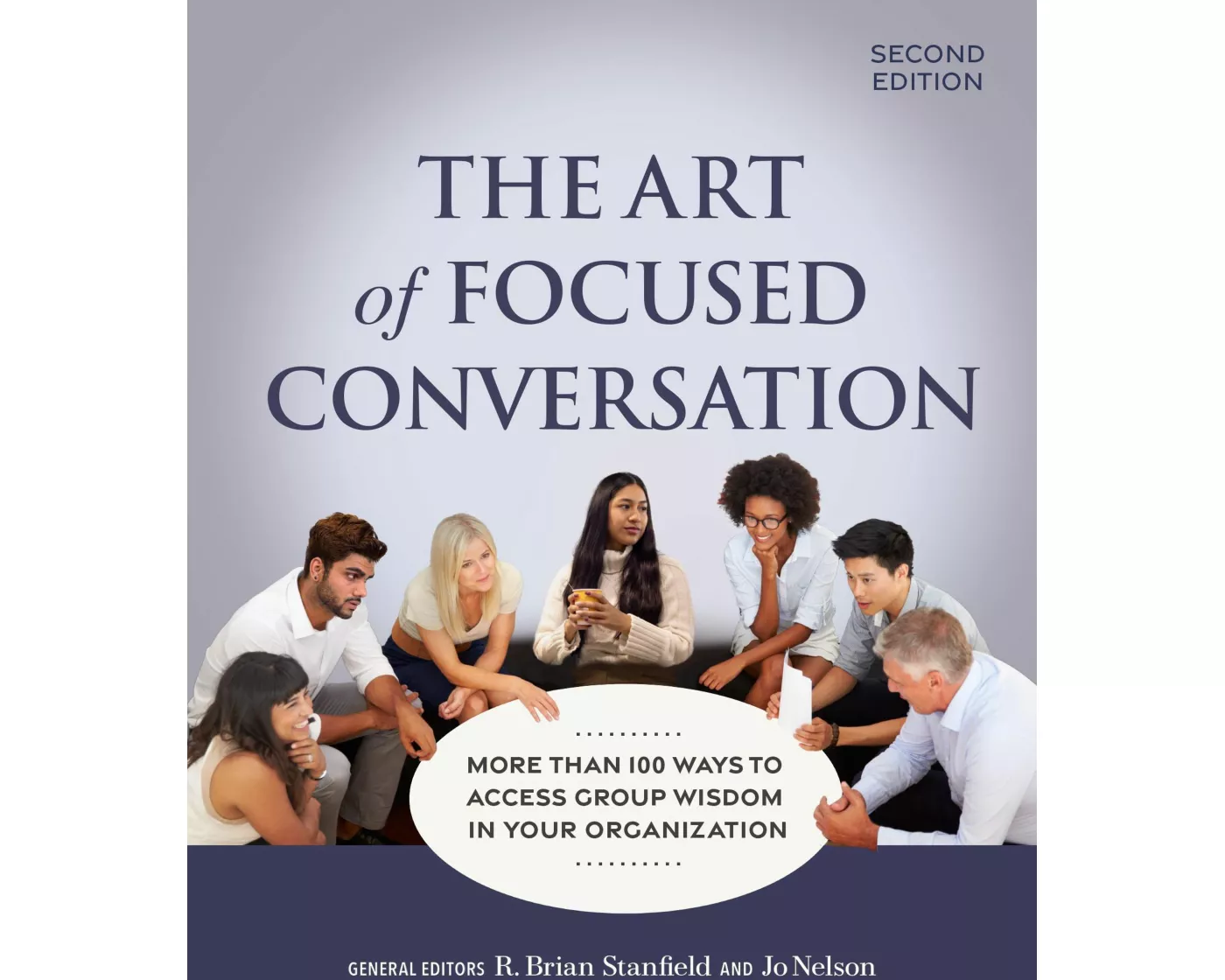
The Art of Focused Conversation, Second Edition
More Than 100 Ways to Access Group Wisdom in Your Organization
Herausgegeben von R. Brian Stanfield, Jo Nelson
- Verlag
- New Society Publishers
- Unsere Artikel-Nr.
- Z9VL7RV
Beschreibung
Spezifikationen
| Sprache | Englisch |
|---|---|
| Autor | R. Brian Stanfield, Jo Nelson |
| Erscheinungsjahr | 2024 |
| Format | Buch (Softcover) |
| Anzahl Seiten | 368 |
Inhaltsverzeichnis
Preface
How this Book and Update Came to Be
Attributions and Gratitude
Introduction:
Origins of the Method
Part 1: Theory and Practice
Ch. 1. Why Do Organizations Need Conversations?
Ch. 2. Focused Conversation Method Overview
Ch. 3. Underlying Structure of the Focused Conversation Method
Ch. 4. How Science Supports Focused Conversations
Ch. 5. Preparing a Conversation from Scratch
Ch. 6. Leading a Conversation
Ch. 7. Troubleshooting - Common Problems and Suggested Solutions
Part 2: Sample Conversations Introduction to the Sample Conversations
Section A. Preparing and Planning
A1. Preparing a short presentation
A2. Getting input into writing a response to a book or article
A3. Preparing a group to write a progress report or status update
A4. Preparing a strategic presentation on a new product.
A5. Assessing marketplace trends
A6. Preparing for the impact of government regulations on a product
A7. Planning an organizational community of practice
A8. Preparing the agenda for a meeting
A9. Identifying key themes to be discussed at a subsequent meeting
A10. Establishing priority of topics to be discussed
A11. Planning an event
A12. Working on a promotional piece
A13. Selecting a theme for an upcoming conference
A14. Preparing a symbol and slogan for a public campaign
A15. Designing new customer service procedures
A16. Preparing for strategic planning (through reflection)
A17. Focusing a group on a shared problem
A18. Introducing a new training topic
A19. Assembling a budget
A20. Redesigning office space
A21. Organizing an in-house special interest group
Section B. Making Decisions
B1. Deciding work priorities
B2. Determining program priorities
B3. Developing terms of reference for a major project evaluation.
B4. Discussing a staff response to a consultant report
B5. Implementing a new board policy
B6. Reworking office operating guidelines
B7. Making assignments within a team
B8. Deciding on a trade show strategy
B9. Reframing a team's mission
B10. Helping a workmate think through a decision
B11. Breaking up a decisional logjam in a group
B12. Dealing with work environment issues
B13. Identifying gaps between a future state and a current state.
Section C. Managing and Supervising
C1. Canvassing employees
C2. Reviewing a work description
C3. Interviewing a job applicant
C4. Conducting a performance appraisal
C5. New managers' reflection on their leadership roles
C6. Musing on a frustrating meeting
C7. Reflecting on a chaotic meeting
C8. Creating participation guidelines
C9. Dealing with delegation issues
C10. Interpreting a shop-floor grievance
C11. Discussing an unexpected and disruptive impact
C12. Discussing staff dissatisfaction
C13. Naming market influences
C14. Analyzing sales statistics
C15. Highlighting the comparative profile of the firm
C16. Reflecting on a transition
C17. Assessing the impact of a training experience
C18. Building phased timeline for a restructuring project
C19. Reflecting on organizational change
C20. Analyzing budget performance
C21. Troubleshooting a stalled project
C22. Collaborating on a supply program
C23. Reflecting on a proposal for departmental reorganization
C24. Reflecting on a recent decision
Section D. Evaluating and Reviewing
D1. Reviewing a workshop
D2. Reviewing the day with a group
D3. Reviewing a planning event
D4. Reviewing the year
D5. Reviewing an organization's past
D6. Reviewing a consultant's presentation
D7: Reviewing a major report
D8. Understanding the ongoing effects of a major event on individuals
D9. Discussing an article
D10. Evaluating a proposal
D11. Evaluating a course
D12. Evaluating a curriculum
D13. Evaluating the progress of a project, or conducting a lessons learned
D14. Evaluating a marketing campaign
D15. Analyzing a product that failed to sell
D16. Evaluating a service offering
D17. Evaluating a new software package
D18. Evaluating a conference
D19. Understanding and applying expert recommendations
D20. Evaluating the impact of world events
Section E. Coaching and Mentoring
E1. Coaching a colleague
E2. Talking through a job description
E3. Mentoring a new employee
E4. Holding an employee to account
E5. Discussing a set of employee guidelines
E6. Reflecting on evaluations with instructors
E7. Meditating on a difficult situation
E8. Mentoring a staff person about a family crisis affecting work #1
E9. Mentoring a staff person about a family crisis affecting work #2
E10. Processing a traumatic event with an employee
E11.Inspiring the team with a story
E12. Debriefing a training video
E13. Creating a practice of journaling
E14. Reflecting on one's life journey
E15. Planning for personal growth
Section F. Supporting Diversity and Belonging
F1. Assessing the diversity of the organization
F2. Reviewing policies to strengthen diversity, equity and inclusion
F3. Planning for internationally trained workers
F4. Determining accommodation needs
F5. Manager's reflection on an employee's challenge
F6. Reflecting on a belittling (derogatory) experience
F7. Support after derogatory comments
F8. Becoming aware of micro-aggressions
F9. Uncovering unconscious bias
Section G. Resolving Conflict
G1. Resolving a personal conflict
G2. Personal reflection on a conflict
G3. Responding to a personal complaint
G4. Calming an upset customer
G5. Initiating dialogue to understand a conflict
G6. Resolving a dispute
G7. Solving a team conflict
G8. Resolving a long-term misunderstanding
Section H. Guiding Personal and Celebrative Reflections
H1. Reflecting on the day
H2. Learning from a life event
H3. Facilitators' internal reflection while leading a group
H4. Appraising an additional assignment
H5. Reflecting on a request to take on a new assignment
H6. Celebrating a great victory
H7. Interviewing the employee of the month
H8. Celebrating a colleague's birthday
H9. Celebrating a retirement: conversation with the individual
H10. Celebrating a retirement: group reflection
Section I. Connecting Work and Life
I1. The after-school conversation
I2. Re-entry after a learning event
I3. Internal reflection in a crisis
I4. Resolving a family dispute
I5. Processing a traumatic event with family
Appendices
Appendix 1. Possible Tangible Beginning Points
Appendix 2. Sample Questions at Each Level
Appendix 3. Visuals of the Flow of a Focused Conversation
Appendix 4. Guide for Preparing a Conversation
Appendix 5. Conversation Planning Worksheet
Appendix 6. Example: A Plan using the Worksheet
Appendix 7. Example: A Conversation with Typical Answers
Appendix 8. Leading an Informal Conversation
Appendix 9. Using Focused Conversation Method with Other ToP methods
Appendix 10. Introduction to Image Change
Appendix 11. Sample of Other Methods that Follow ORID
Index
Bibliography
About ICA
Bewertungen
Produkt bewertenFür dieses Produkt liegt noch keine Bewertung vor. Wenn Sie es gekauft haben, teilen Sie gerne Ihre Erfahrung.
Zahlungsarten


Rechnung (Einzahlungsschein mit QR-Code), Twint, Kreditkarte, PostFinance, Apple, Google oder Samsung Pay.
Versand
Kostenlos: Schweiz & Liechtenstein
Rückgabe
Kein Rückgaberecht
Bei diesem Produkt hat entweder der Hersteller/Verlag das Rückgaberecht ausgeschlossen oder eine Rückgabe ist aufgrund des Vertriebssystems nicht möglich.