
Auf Lager:1Buch (Softcover): Fachbuch
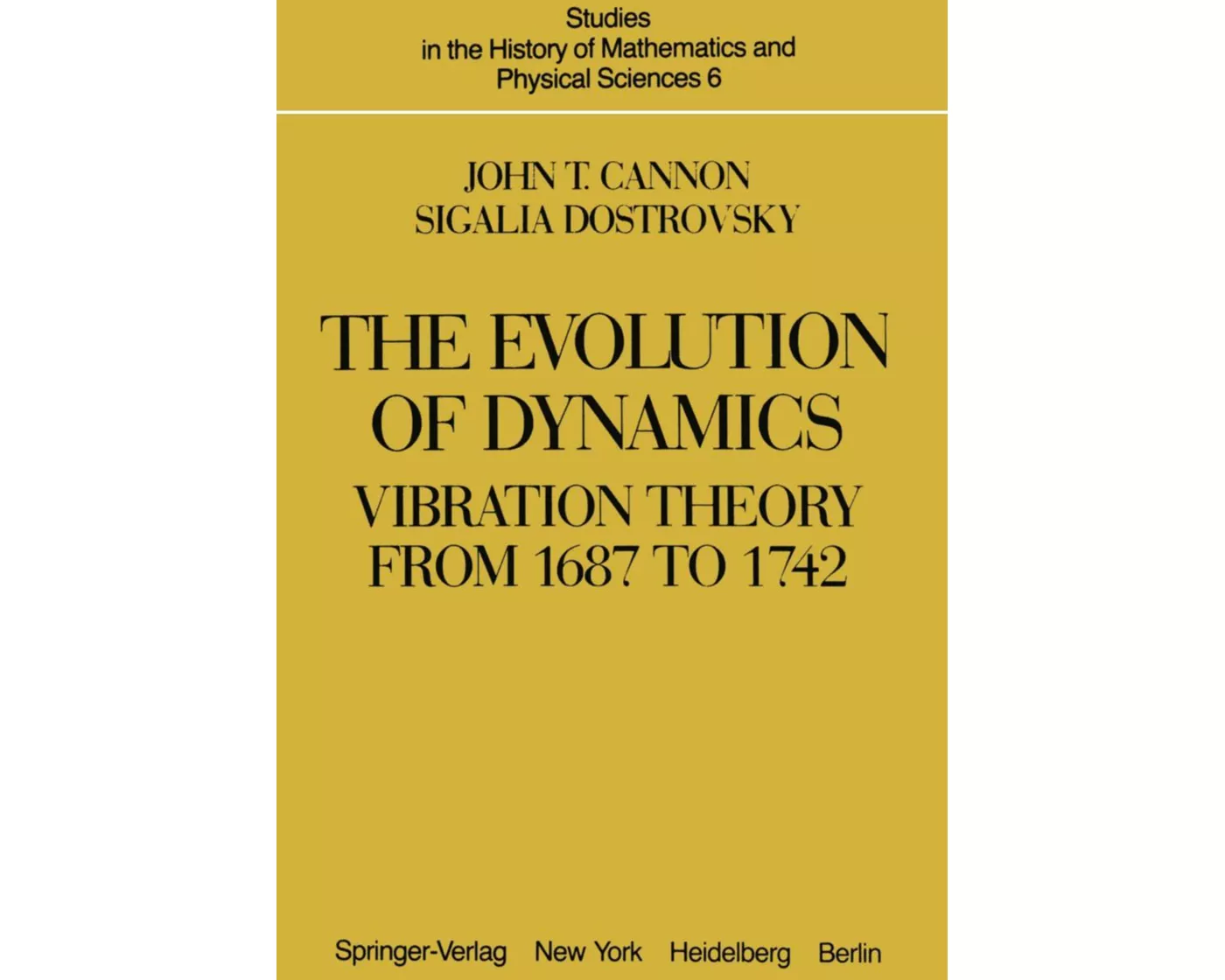
The Evolution of Dynamics: Vibration Theory from 1687 to 1742
Vibration Theory from 1687 to 1742
von J. T. Cannon, S. Dostrovsky
- Verlag
- Springer Verlag
- Unsere Artikel-Nr.
- WWKV8VE
Beschreibung
In this study we are concerned with Vibration Theory and the Problem of Dynamics during the half century that followed the publication of Newton's Principia. The relationship that existed between these subject. is obscured in retrospection for it is now almost impossible not to view (linear) Vibration Theory as linearized Dynamics. But during the half century in question a theory of Dynamics did not exist; while Vibration Theory comprised a good deal of acoustical information, posed definite problems and obtained specific results. In fact, it was through problems posed by Vibration Theory that a general theory of Dynamics was motivated and discovered. Believing that the emergence of Dynamics is a critically important link in the history of mathematical science, we present this study with the primary goal of providing a guide to the relevant works in the aforemen tioned period. We try above all to make the contents of the works readily accessible and we try to make clear the historical connections among many of the pertinent ideas, especially those pertaining to Dynamics in many degrees of freedom. But along the way we discuss other ideas on emerging subjects such as Calculus, Linear Analysis, Differential Equations, Special Functions, and Elasticity Theory, with which Vibration Theory is deeply interwound. Many of these ideas are elementary but they appear in a surprising context: For example the eigenvalue problem does not arise in the context of special solutions to linear problems-it appears as a condition for isochronous vibrations.
Spezifikationen
| Sprache | Englisch |
|---|---|
| Autor | J. T. Cannon, S. Dostrovsky |
| Kollektion | Studies in the History of Mathematics and Physical Sciences |
| Erscheinungsjahr | 2011 |
| Erscheinungsland | USA |
| Format | Buch (Softcover) |
| Anzahl Seiten | 196 |
Inhaltsverzeichnis
1. Introduction.- 2. Newton (1687).- 2.1. Pressure Wave.- 2.2. Remarks.- 3. Taylor (1713).- 3.1. Vibrating String.- 3.2. Absolute Frequency.- 3.3. Remarks.- 4. Sauveur (1713).- 4.1. Vibrating String.- 4.2. Remarks.- 5. Hermann (1716).- 5.1. Pressure Wave.- 5.2. Vibrating String.- 5.3. Remarks.- 6. Cramer (1722).- 6.1. Sound.- 6.2. Remarks.- 7. Euler (1727).- 7.1. Vibrating Ring.- 7.2. Sound.- 8. Johann Bernoulli (1728).- 8.1. Vibrating String (Continuous and Discrete).- 8.2. Remark on the Energy Method.- 9. Daniel Bernoulli (1733; 1734); Euler (1736) …..- 9.1. Linked Pendulum and Hanging Chain.- 9.2. Laguerre Polynomials and J0.- 9.3. Double and Triple Pendula.- 9.4. Roots of Polynomials.- 9.5. Zeros of J0.- 9.6. Other Boundary Conditions.- 9.7. The Bessel Functions Jv.- 10. Euler (1735).- 10.1. Pendulum Condition.- 10.2. Vibrating Rod.- 10.3. Remarks.- 11. Johann II Bernoulli (1736).- 11.1. Pressure Wave.- 11.2. Remarks.- 12. Daniel Bernoulli (1739; 1740).- 12.1. Floating Body.- 12.2. Remarks.- 12.3. Dangling Rod.- 12.4. Remarks on Superposition.- 13. Daniel Bernoulli (1742).- 13.1. Vibrating Rod.- 13.2. Absolute Frequency and Experiments.- 13.3. Superposition.- 14. Euler (1742).- 14.1. Linked Compound Pendulum.- 14.2. Dangling Rod and Weighted Chain.- 15. Johann Bernoulli (1742) no.- 15.1. One Degree of Freedom.- 15.2. Dangling Rod.- 15.3. Linked Pendulum I.- 15.4. Linked Pendulum II.- Appendix: Daniel Bernoulli’s Papers on the Hanging Chain and the Linked Pendulum.- Theoremata de Oscillationibus Corporum.- De Oscillationibus Filo Flexili Connexorum.- Theorems on the Oscillations of Bodies.- On the Oscillations of Bodies Connected by a Flexible Thread.
Bewertungen
Produkt bewertenFür dieses Produkt liegt noch keine Bewertung vor. Wenn Sie es gekauft haben, teilen Sie gerne Ihre Erfahrung.
Zahlungsarten


Rechnung (Einzahlungsschein mit QR-Code), Twint, Kreditkarte, PostFinance, Apple, Google oder Samsung Pay.
Versand
Kostenlos: Schweiz & Liechtenstein
Rückgabe
30 Tage Rückgaberecht
Sie können das Produkt innerhalb von 30 Wochentagen ohne Angabe von Gründen zurücksenden, sofern es unbeschädigt und in der Originalverpackung ist.
Weitere Hinweise finden Sie in unseren AGB unter D.1.