
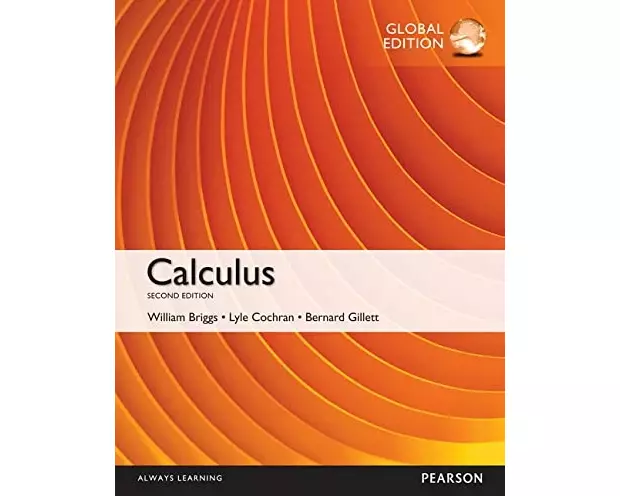
Calculus, Global Edition
von Lyle Cochran, William Briggs, Bernard Gillett
- Verlag
- Pearson
- Unsere Artikel-Nr.
- 53GZRK3
Beschreibung
Spezifikationen
| Sprache | Englisch |
|---|---|
| Autor | Lyle Cochran, William Briggs, Bernard Gillett |
| Thema | Mathematische Analysis: Allgemein |
| Auflage | 2 |
| Erscheinungsjahr | 2014 |
| Format | Buch (Softcover) |
| Anzahl Seiten | 1328 |
Inhaltsverzeichnis
1. Functions <\/b><\/p>
1.1 Review of functions <\/p>
1.2 Representing functions<\/p>
1.3 Trigonometric functions<\/p>
1.4 Trigonometric functions<\/p>
<\/p>
2. Limits<\/b><\/p>
2.1 The idea of limits<\/p>
2.2 Definitions of limits<\/p>
2.3 Techniques for computing limits <\/p>
2.4 Infinite limits <\/p>
2.5 Limits at infinity <\/p>
2.6 Continuity<\/p>
2.7 Precise definitions of limits <\/p>
<\/p>
3. Derivatives<\/b><\/p>
3.1 Introducing the derivative<\/p>
3.2 Working with derivatives<\/p>
3.3 Rules of differentiation<\/p>
3.4 The product and quotient rules<\/p>
3.5 Derivatives of trigonometric functions <\/p>
3.6 Derivatives as rates of change <\/p>
3.7 The Chain Rule <\/p>
3.8 Implicit differentiation <\/p>
3.9 Related rates<\/p>
<\/p>
4. Applications of the Derivative<\/b><\/p>
4.1 Maxima and minima <\/p>
4.2 What derivatives tell us <\/p>
4.3 Graphing functions <\/p>
4.4 Optimization problems <\/p>
4.5 Linear approximation and differentials <\/p>
4.6 Mean Value Theorem<\/p>
4.7 L’Hôpital’s Rule <\/p>
4.8 Newton’s Method <\/p>
4.9 Antiderivatives<\/p>
<\/p>
5. Integration<\/b><\/p>
5.1 Approximating areas under curves<\/p>
5.2 Definite integrals <\/p>
5.3 Fundamental Theorem of Calculus <\/p>
5.4 Working with integrals <\/p>
5.5 Substitution rule<\/p>
<\/p>
6. Applications of Integration<\/b><\/p>
6.1 Velocity and net change<\/p>
6.2 Regions between curves<\/p>
6.3 Volume by slicing<\/p>
6.4 Volume by shells<\/p>
6.5 Length of curves<\/p>
6.6 Surface area<\/p>
6.7 Physical applications<\/p>
<\/p>
7. Logarithmic and Exponential Functions<\/b><\/p>
7.1 Inverse functions<\/p>
7.2 The natural logarithmic and exponential functions<\/p>
7.3 Logarithmic and exponential functions with other bases<\/p>
7.4 Exponential models<\/p>
7.5 Inverse trigonometric functions<\/p>
7.6 L’ Hôpital’s Rule and growth rates of functions<\/p>
7.7 Hyperbolic functions<\/p>
<\/p>
8. Integration Techniques<\/b><\/p>
8.1 Basic approaches<\/p>
8.2 Integration by parts <\/p>
8.3 Trigonometric integrals <\/p>
8.4 Trigonometric substitutions<\/p>
8.5 Partial fractions <\/p>
8.6 Other integration strategies<\/p>
8.7 Numerical integration<\/p>
8.8 Improper integrals<\/p>
8.9 Introduction to differential equations<\/p>
<\/p>
9. Sequences and Infinite Series<\/b><\/p>
9.1 An overview <\/p>
9.2 Sequences<\/p>
9.3 Infinite series <\/p>
9.4 The Divergence and Integral Tests<\/p>
9.5 The Ratio, Root, and Comparison Tests<\/p>
9.6 Alternating series <\/p>
<\/p>
10. Power Series<\/b><\/p>
10.1 Approximating functions with polynomials<\/p>
10.2 Properties of Power series<\/p>
10.3 Taylor series<\/p>
10.4 Working with Taylor series<\/p>
<\/p>
11. Parametric and Polar Curves <\/b><\/p>
11.1 Parametric equations<\/p>
11.2 Polar coordinates <\/p>
11.3 Calculus in polar coordinates <\/p>
11.4 Conic sections <\/p>
<\/p>
12. Vectors and Vector-Valued Functions<\/b><\/p>
12.1 Vectors in the plane<\/p>
12.2 Vectors in three dimensions<\/p>
12.3 Dot products<\/p>
12.4 Cross products<\/p>
12.5 Lines and curves in space <\/p>
12.6 Calculus of vector-valued functions <\/p>
12.7 Motion in space<\/p>
12.8 Length of curves<\/p>
12.9 Curvature and normal vectors<\/p>
<\/p>
13. Functions of Several Variables<\/b><\/p>
13.1 Planes and surfaces<\/p>
13.2 Graphs and level curves<\/p>
13.3 Limits and continuity<\/p>
13.4 Partial derivatives<\/p>
13.5 The Chain Rule <\/p>
13.6 Directional derivatives and the gradient<\/p>
13.7 Tangent planes and linear approximation<\/p>
13.8 Maximum\/minimum problems<\/p>
13.9 Lagrange multipliers<\/p>
<\/p>
14. Multiple Integration<\/b><\/p>
14.1 Double integrals over rectangular regions<\/p>
14.2 Double integrals over general regions<\/p>
14.3 Double integrals in polar coordinates<\/p>
14.4 Triple integrals<\/p>
14.5 Triple integrals in cylindrical and spherical coordinates<\/p>
14.6 Integrals for mass calculations<\/p>
14.7 Change of variables in multiple integrals<\/p>
<\/p>
15. Vector Calculus<\/b><\/p>
15.1 Vector fields<\/p>
15.2 Line integrals<\/p>
15.3 Conservative vector fields<\/p>
15.4 Green’s theorem<\/p>
15.5 Divergence and curl<\/p>
15.6 Surface integrals<\/p>
15.6 Stokes’ theorem<\/p>
15.8 Divergence theorem<\/p>
<\/p>
Appendix A. Algebra Review<\/p>
Appendix B. Proofs of Selected Theorems<\/p>
<\/p>
D1 Differential Equations (online)<\/b><\/p>
D1.1 Basic Ideas<\/p>
D1.2 Direction Fields and Euler’s Method<\/p>
D1.3 Separable Differential Equations<\/p>
D1.4 Special First-Order Differential Equations<\/p>
D1.5 Modeling with Differential Equations<\/p>
<\/p>
D2 Second-Order Differential Equations (online)<\/b><\/p>
D2.1 Basic Ideas<\/p>
D2.2 Linear Homogeneous Equations<\/p>
D2.3 Linear Nonhomogeneous Equations<\/p>
D2.4 Applications<\/p>
D2.5 Complex Forcing Functions<\/p>
Bewertungen
Produkt bewertenFür dieses Produkt liegt noch keine Bewertung vor. Wenn Sie es gekauft haben, teilen Sie gerne Ihre Erfahrung.
Zahlungsarten


Rechnung (Einzahlungsschein mit QR-Code), Twint, Kreditkarte, PostFinance, Apple, Google oder Samsung Pay.
Versand
Kostenlos: Schweiz & Liechtenstein
Rückgabe
30 Tage Rückgaberecht
Sie können das Produkt innerhalb von 30 Wochentagen ohne Angabe von Gründen zurücksenden, sofern es unbeschädigt und in der Originalverpackung ist.
Weitere Hinweise finden Sie in unseren AGB unter D.1.